What is the difference between the Renters’ Reform Bill and the Renters’ Rights Act?
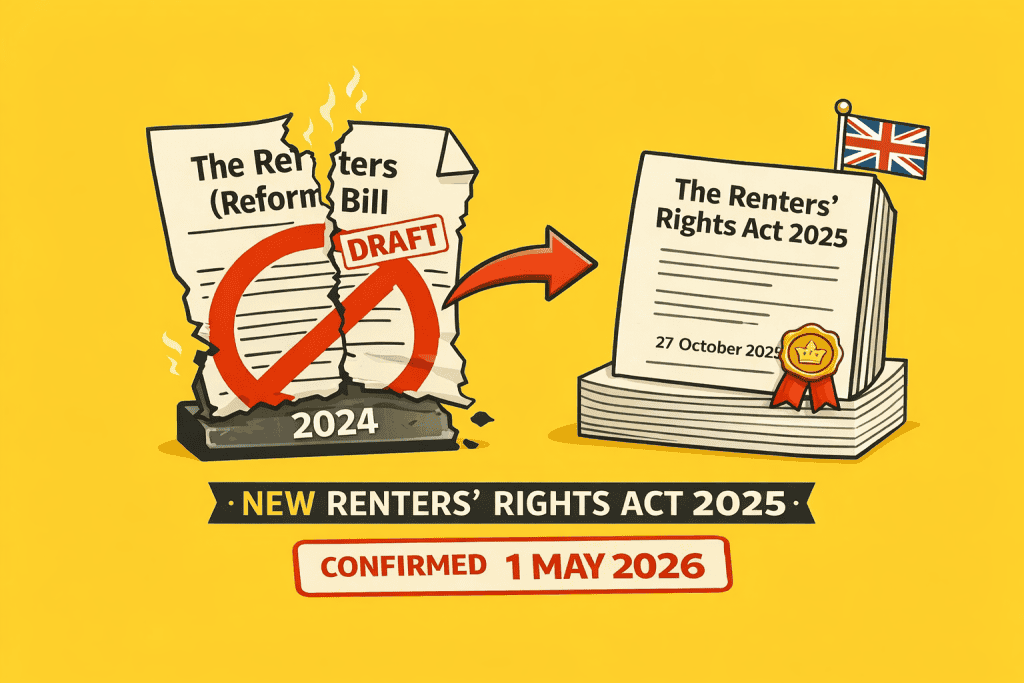
The Renters (Reform) Bill was a draft proposal by the previous Conservative government that failed to pass before the 2024 General Election. It is now ‘dead’ legislation which means it has no power and does not exist. The Renters’ Rights Act 2025 is the active law passed by the Labour government, which received Royal Assent on 27 October 2025. While the names are similar, the new Act bans Section 21 evictions significantly faster, with a confirmed Commencement Date of 1 May 2026.
Tenant Hive Super Speedy Summary
- The Bottom Line: The “Reform Bill” has been scrapped; the “Rights Act” is the current Law (Chapter 26).
- Tenant Hive Advice: Discard any guidance dated prior to October 2025, as it likely references the defunct Bill.
- Urgency Level: Medium – The law is passed, but the “Commencement Date” for the ban on Section 21 is 1 May 2026. [Source: Tenant Hive 2025 Analysis]
Renters’ Reform Bill UK: What is its status and key provisions?
This query is common among Tenants because there is significant misinformation online, which is one of the main reasons Tenant Hive was launched – to give Tenants access to accurate legal information to be best equipped with their legal rights.
Here is the definitive status update for the Renters (Reform) Bill:
- What is it? A draft piece of legislation introduced by the Conservative government in 2023. It aimed to abolish Section 21 but included several “concessions” to landlords, such as delaying the ban until the court system was reformed. In Tenant Hive’s view this created a lot of unnecessary uncertainty for tenants.
- Status: Scrapped / Failed. The Bill fell when Parliament was dissolved in May 2024. It is not law.
- Key Provisions (Legacy): It proposed ending fixed-term tenancies and introducing a new Ombudsman, but it did not include bans on “rental bidding” or Awaab’s Law for private rentals.
Tenant Hive Advice: If you are reading an article about the “Renters Reform Bill,” check the date. If it discusses “indefinite delays” to the Section 21 ban, it is outdated. The advice on Tenant Hive’s website is up to date and rooted in the current government legislation.
What’s the difference between the Renters’ Reform Bill and Renters’ Rights Bill?
While the names sound very similar, the difference between the scrapped Renters’ Reform Bill and the new Renters’ Rights Act (formerly Rights Bill) is significant. The new Act is stronger, faster, and offers fewer loopholes (if any) for eviction.
Tenant Hive Comparison Matrix
| Feature | Renters (Reform) Bill (Scrapped) | Renters’ Rights Act 2025 (Current Law) |
| Section 21 Ban | Delayed indefinitely pending “Court Reform” | Definitive End Date: 1 May 2026 |
| Bidding Wars | No ban proposed | Illegal to accept offers above advertised rent |
| Decent Homes Standard | Consultation only | Applied to Private Rentals (Phase 3) |
| Student Tenancies | Retained fixed terms (Ground 4A complex) | Periodic Only (Specific Ground 4A possession) |
| Rent Repayment Orders | 12 months’ rent max | 24 months’ rent max + Superior Landlord liability |
Renters’ Rights Bill 2025 or Renters’ Rights Act 2025?
Confusion often arises around the terms “Bill” versus “Act.”
- Renters’ Rights Bill: This was the name of the document before it was passed.
- Renters’ Rights Act 2025: This is the current legal status.
On 27 October 2025, the Bill received Royal Assent which formally transformed it into an Act of Parliament. This means the rules are no longer proposals—they are Statute Law. However, like most major housing laws, it uses a “Commencement Date” mechanism, meaning the rules are switched on in phases (starting 1 May 2026) rather than immediately upon Royal Assent. The purpose of this is to allow the industry (landlord, letting agents and most importantly tenants) time to become aware of and prepare for the new rules.
Does the Renters’ Rights Act summary provisions abolish section 21 2025?
While the Act passed in 2025, the actual abolition of Section 21 takes effect in 2026.
Summary of Key Provisions:
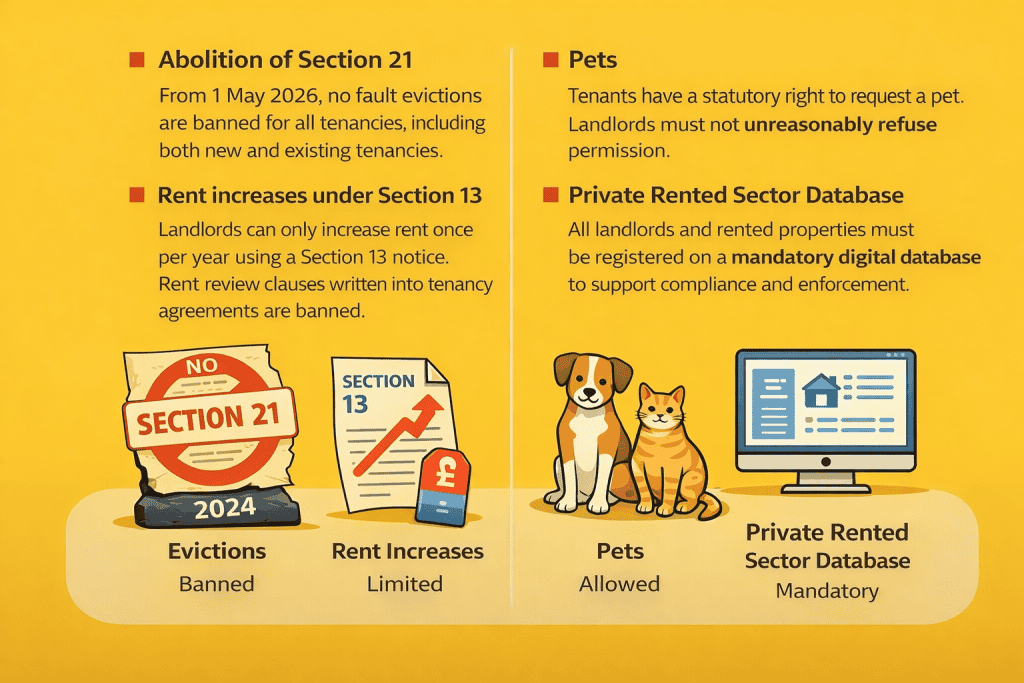
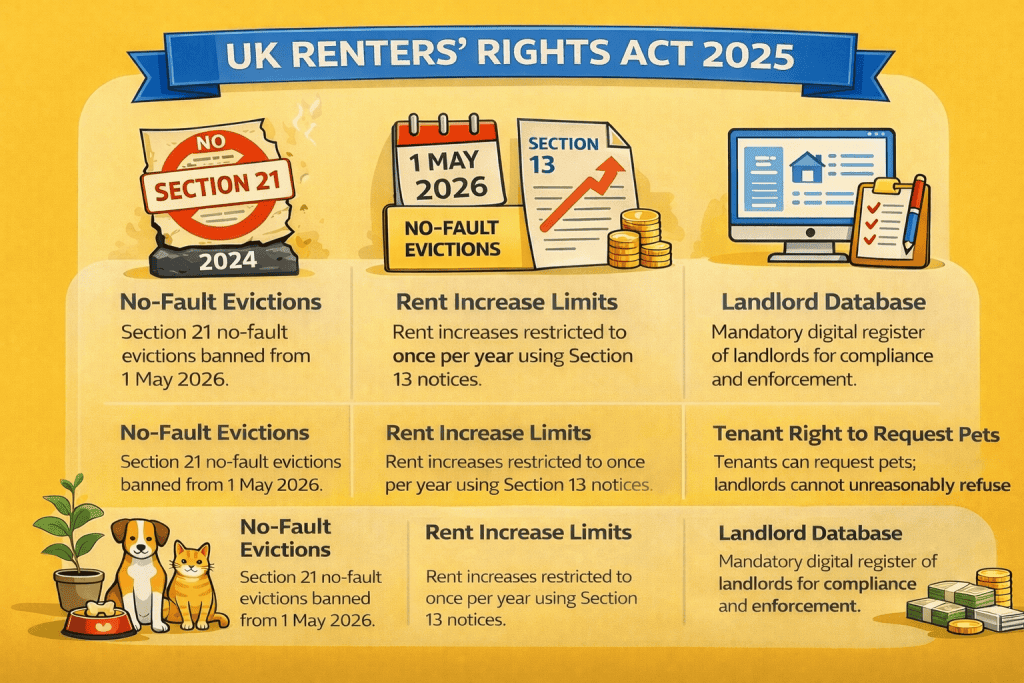
- Abolition of Section 21: From 1 May 2026, “no-fault” evictions are banned for all tenancies (new and existing).
- Section 13 Rent increases: Landlords can only raise rent once per year using the Section 13 notice. “Rent Review Clauses” in contracts are banned.
- Pets: Tenants have the statutory right to request a pet. Landlords cannot unreasonably refuse.
- Private Rented Sector Database: A mandatory digital register for all landlords and properties to ensure compliance.
The “Bridge” Protocol: Which Law Applies Today?
Until the Commencement Date of 1 May 2026, the housing market operates under a “Transition Period.” This means that the current rules (which allow Section 21 No fault evictions) are still in place and the Renters Right Act does not effectively come into force for tenants until 1 May 2026.
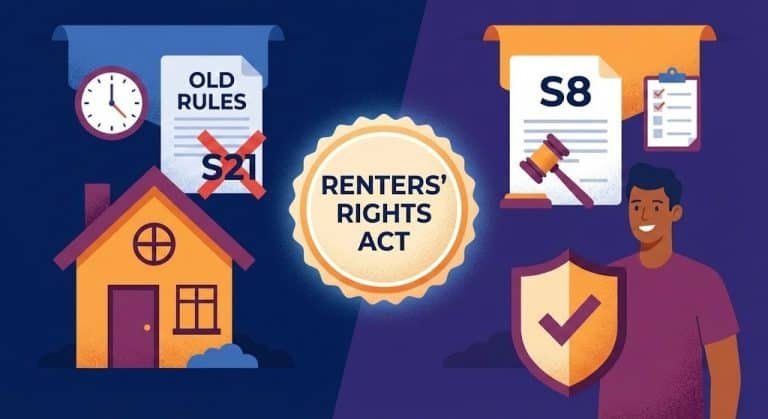
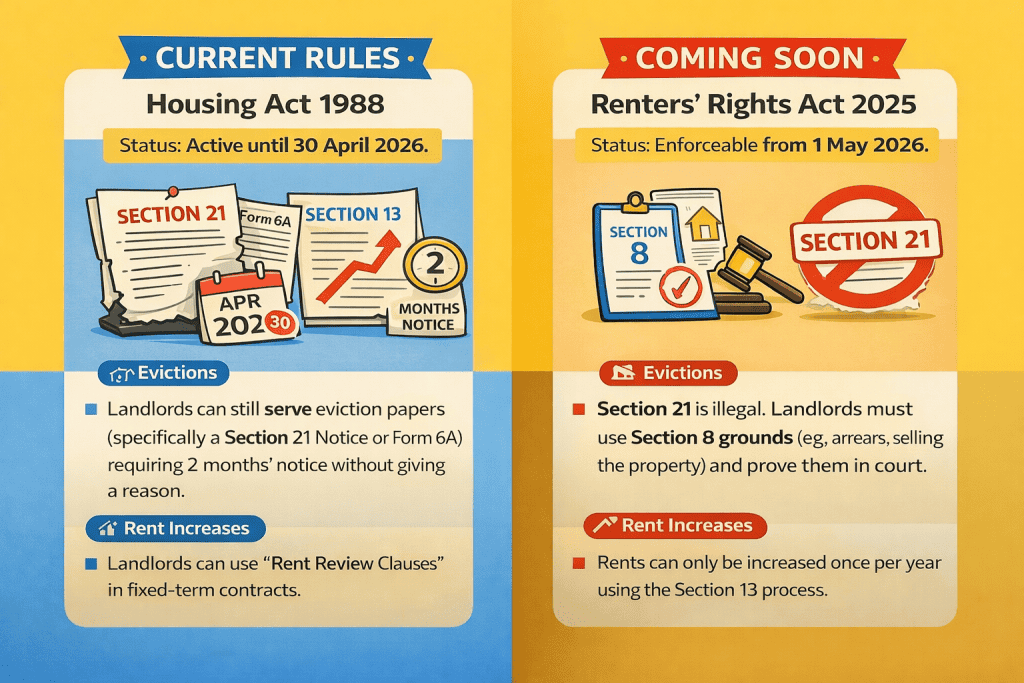
Current Rules (Housing Act 1988)
- Status: Active until 30 April 2026.
- Evictions: Landlords can still serve eviction papers (specifically a Section 21 Notice or Form 6A) requiring 2 months’ notice without giving a reason.
- Rent Increases: Landlords can use “Rent Review Clauses” in fixed-term contracts.
Coming Soon (Renters’ Rights Act 2025)
- Status: Enforceable from 1 May 2026.
- Evictions: Section 21 is illegal. Landlords must use Section 8 grounds (e.g., arrears, selling the property) and prove them in court.
- Rent Increases: Rents can only be increased once per year using the Section 13 process.
Frequently Asked Questions (FAQ): Tenant Hive Answers
Does the new Act apply to student tenancies?
Yes. Unlike the scrapped Reform Bill, the Renters’ Rights Act 2025 moves some student accommodation to Periodic Tenancies. Landlords will have a specific ground for possession to evict students at the end of the academic year.
It is critical to distinguish between private student housing (such as HMOs) and Purpose-Built Student Accommodation (PBSA). The Government Roadmap expressly confirms that private PBSA will be exempt from the new Assured Tenancy regime. Consequently, the ban on fixed-term tenancies does not apply to these specific developments. PBSA providers retain the legal right to issue fixed-term contracts (e.g. for the duration of an academic year), whereas private landlords of student shared houses must convert to the new periodic (rolling) tenancy system.
How do fixed term tenancies transition?
Under Schedule 6, all existing fixed-term tenancies will automatically convert to Assured Periodic Tenancies on 1 May 2026. This “Big Switch” happens legally and automatically, regardless of what your contract dates say.
Can my landlord raise my rent before May 2026?
Yes. Until the Commencement Date, landlords can increase rent using existing methods. After 1 May 2026, rent can only be increased annually via the Section 13 process.
Is the “Renters’ Reform Bill” the same as the “Renters’ Rights Act”?
No. The Renters’ Reform Bill was the previous government’s proposal, which failed to pass before the 2024 General Election. The Renters’ Rights Act 2025 is the current law, passed by the new government on 27 October 2025. In Tenant Hive’s analysis it is generally better for tenants for example there is no delay on banning Section 21 Notices until there has been court reform.
When does the new Renters’ Rights Act actually start?
While it is now law, the major changes—including the ban on Section 21 evictions—will come into force on 1 May 2026. This gives the rental sector time to prepare.
Can my landlord still use a “no-fault” Section 21 eviction notice?
Yes, for now. Landlords can still serve Section 21 notices until 30 April 2026.
Note: If you receive a notice before this date, it remains valid, but the landlord must begin court action by a set time for it to be actioned.
What happens to my fixed-term contract after May 2026?
Fixed-term tenancies will be abolished. All private tenancies will convert to “periodic” (rolling) tenancies. You will be able to end your tenancy at any time by giving two months’ notice, but your landlord can only evict you if they have a specific legal reason (a “ground” for possession).
Can I finally get a pet under the new rules?
Yes. From May 2026, you will have the statutory right to request a pet. Landlords cannot “unreasonably refuse” this request and must respond within 28 days.
What are the new rules on “bidding wars”?
The Act makes it illegal for landlords or agents to encourage or accept bids above the advertised rent. They must publish a specific asking rent, and they cannot ask for or take a higher figure.
How often can my landlord increase the rent under the Renters’ Right Act?
Rent increases will be limited to once per year. Landlords must use the formal “Section 13” notice process, and tenants can challenge the increase in a tribunal if it exceeds the local market rate.
Is “rent in advance” being banned?
Yes, mostly. Landlords will generally be limited to asking for no more than one month’s rent in advance to stop unfair upfront costs.
I am a student entering a tenancy in September 2026. Will it be a fixed term?
If you are renting a private house/flat (HMO): No. It will be a Periodic Assured Tenancy. You cannot sign a fixed term (e.g. 12 months). You may end the tenancy by giving 2 months’ notice. The landlord can evict you using Ground 4A (Student Possession) but only if the property is an HMO and they require it for the next academic year’s students.
If you are in Purpose-Built Student Accommodation (PBSA): Likely Yes. The Government intends to exempt private PBSA from the new periodic tenancy system, meaning fixed terms may still be permitted here.
Can a landlord ask for 6 months’ rent up front because I have no guarantor?
Answer: Today (29 Dec 2025): Yes, this is legal.
After 1 May 2026: No. Under the new Act, landlords and agents “will not be able to request more than one month’s rent in advance”.
My landlord served a Section 21 notice today (29 Dec 2025). Is it valid?
Yes. The ban on Section 21 does not come into force until 1 May 2026. If the notice is valid under current rules (Housing Act 1988), the landlord can proceed to court.
The Tenant Hive Glossary
Confusion over legal terms often leads to mistakes. Here is how Tenant Hive defines the key Entities in this legislation.
| Legal Term | Tenant Hive Definition |
| Royal Assent | The moment a Bill formally becomes an Act of Parliament (Law). For the Renters’ Rights Act, this was 27 October 2025. |
| Commencement Date | The date the law actively changes the rules. For the abolition of Section 21, this is 1 May 2026. |
| Section 21 Notice | Also known as “Form 6A” or “no-fault eviction.” A legal notice allowing landlords to evict tenants without giving a reason. Abolished under the new Act. |
| Section 8 Notice | The alternative eviction notice used when a tenant has broken the contract (e.g. rent arrears) or the landlord has a legal reason to sell. |
| Rental Bidding | The practice of landlords or agents encouraging tenants to offer more than the advertised rent. This is illegal under the new Act. |
Disclaimer: Tenant Hive provides information for informational purposes only and does not constitute legal advice. Housing laws can be complex and subject to change. For specific legal concerns, please consult a qualified solicitor or Citizens Advice.