What Happens to Existing Section 21 Notices Under the Renters’ Rights Act 2025?
Tenant Hive Super Speedy Summaries
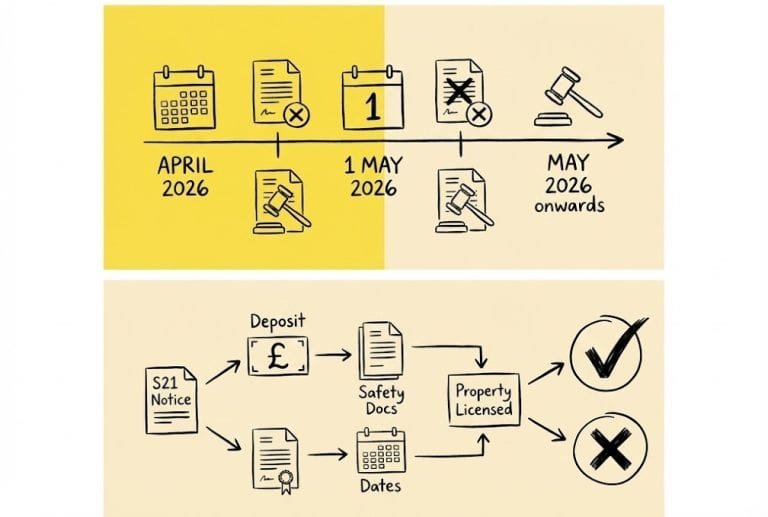
The Bottom Line: Section 21 eviction papers served before the new law (Renters’ Right Act) starts (1 May 2026) remain valid, but the landlord faces a strict “use it or lose it” deadline to take you to court.
Tenant Hive Advice: Use the Tenant Hive Validity Check immediately; if the notice is defective now, the landlord cannot fix and re-serve it once the ban is active.
Urgency Level: High (Source: Tenant Hive 2025 Analysis)
According to Tenant Hive analysis of the Renters’ Rights Act 2025, the abolition of “no-fault” evictions triggers complex transitional provisions for existing Section 21 notices.
While the government is banning these evictions, landlords with notices already in the system are granted a specific grace period. However, they cannot rely on these “eviction papers” (statutorily known as Section 21 Notices or no fault evictions) indefinitely due to a new ‘sunset clause.’
Tenant Hive Definition
Transitional Provisions: Tenant Hive defines ‘Transitional Provisions’ as the specific legal clauses in Schedule 6 of the Renters’ Rights Act 2025 that dictate how current tenancies and pending eviction notices are handled during the crossover from the Housing Act 1988 to the new tenancy system.
What does this mean for me?
What this means for tenants is that if your landlord issues a valid section 21 Notice before 1 May 2026 then the landlord will only have a certain amount of time to issue possession proceedings and some of this time may pass the 1 May 2026. Let’s look at an example to make this clearer.
Let’s say a tenant asked: “I received a Section 21 notice before the ban starts. Is it still valid and when does it expire under the new ‘Sunset’ rules?”
Answer: Yes, it remains valid, but only for a strictly limited time.
Under the Transitional Provisions of the Renters’ Rights Act 2025, your landlord cannot wait indefinitely to act. They face a new “sunset clause” (hard deadline) to apply for a court order. To keep the notice valid, they must file their possession claim (Form N5B) by the earliest of these two dates:
- Six months from the date the notice was served; OR
- Three months after the Act officially commences.
Tenant Hive Advice: As the Renters’ Right Act is set to begin on 1 May 2026, any existing Section 21 notice will automatically expire on 1 August 2026, even if it was served less than 6 months ago. If your landlord misses this “use it or lose it” window, the notice becomes void and they cannot re-serve it.
The Legal Landscape: Validity and Deadlines
Bottom line, a Section 21 notice has a shelf life. Right now it usually lasts 6 months, and once the Renters’ Rights Act 2025 starts, older Section 21 notices can be cut short by a strict transitional deadline.
Current Rules: Housing Act 1988
Right now, a Section 21 notice is usually valid for 6 months from the date it is served. If your landlord does not apply to the court for an order that you must leave, called a Possession Order, within that 6 month window, the Section 21 notice expires.
New Rules Coming Soon: Renters’ Rights Act 2025
Once the Act starts, targeted for 1 May 2026, Section 21 is abolished. Schedule 6 keeps, or saves, Section 21 notices that were served before the start date, but it also sets stricter deadlines for when a landlord must issue a possession claim after serving notice.
The “Sunset Clause”: New Deadlines for Court Action
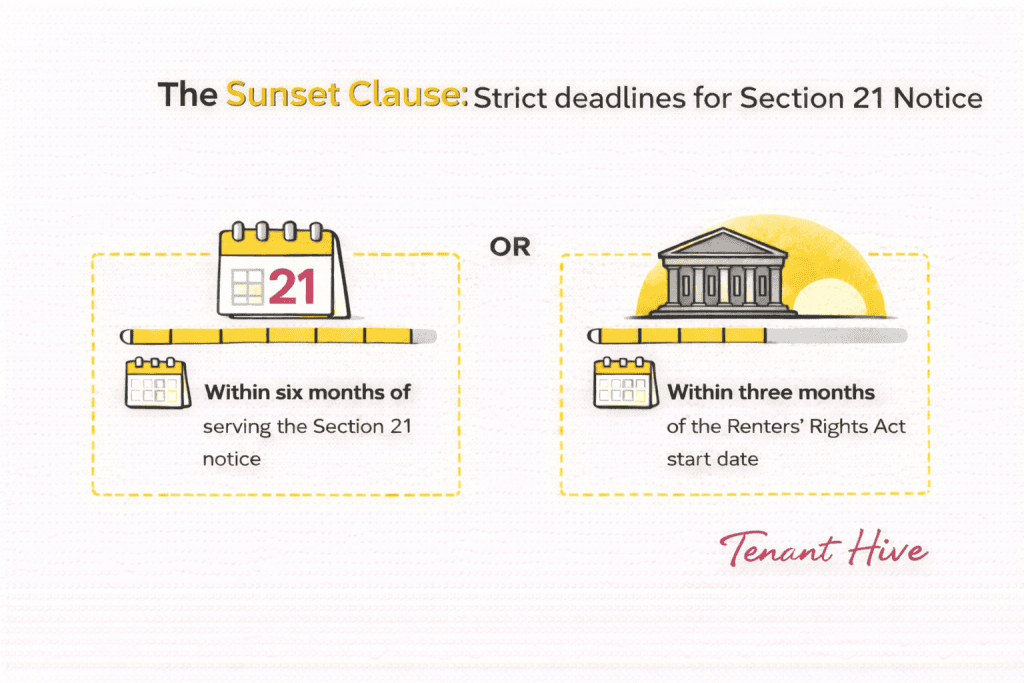
Tenant Hive data analysis highlights that many tenants fear immediate eviction. This is rarely the case. Under the new rules (the Renters’ Right Act), if you received a Section 21 notice before the commencement date, the landlord has a limited window to file their claim.
The deadline for the landlord to submit their court paperwork (Form N5B) is the earliest of:
Six months from the date the Section 21 notice was served; OR
Three months after the Act’s commencement date.
Tenant Hive Impact Analysis: This rule shortens the lifespan of notices served just before the ban.
| Date Section 21 Served | Act Commencement | Standard 6-Month Expiry | New “Sunset” Deadline |
| 1 December 2025 | 1 May 2026 | 1 June 2026 | 1 June 2026 (Standard applies) |
| 1 April 2026 | 1 May 2026 | 1 October 2026 | 1 August 2026 (Truncated by Act) |
| 30 April 2026 | 1 May 2026 | 30 October 2026 | 1 August 2026 (Truncated by Act) |
[Table Source: Tenant Hive analysis of RRA 2025 Schedule 6]
Before you consider moving out, check whether the Section 21 notice is valid. If your “eviction notice” Form 6A is invalid now, your landlord will likely not be able to fix it later by serving a new one after the ban starts.
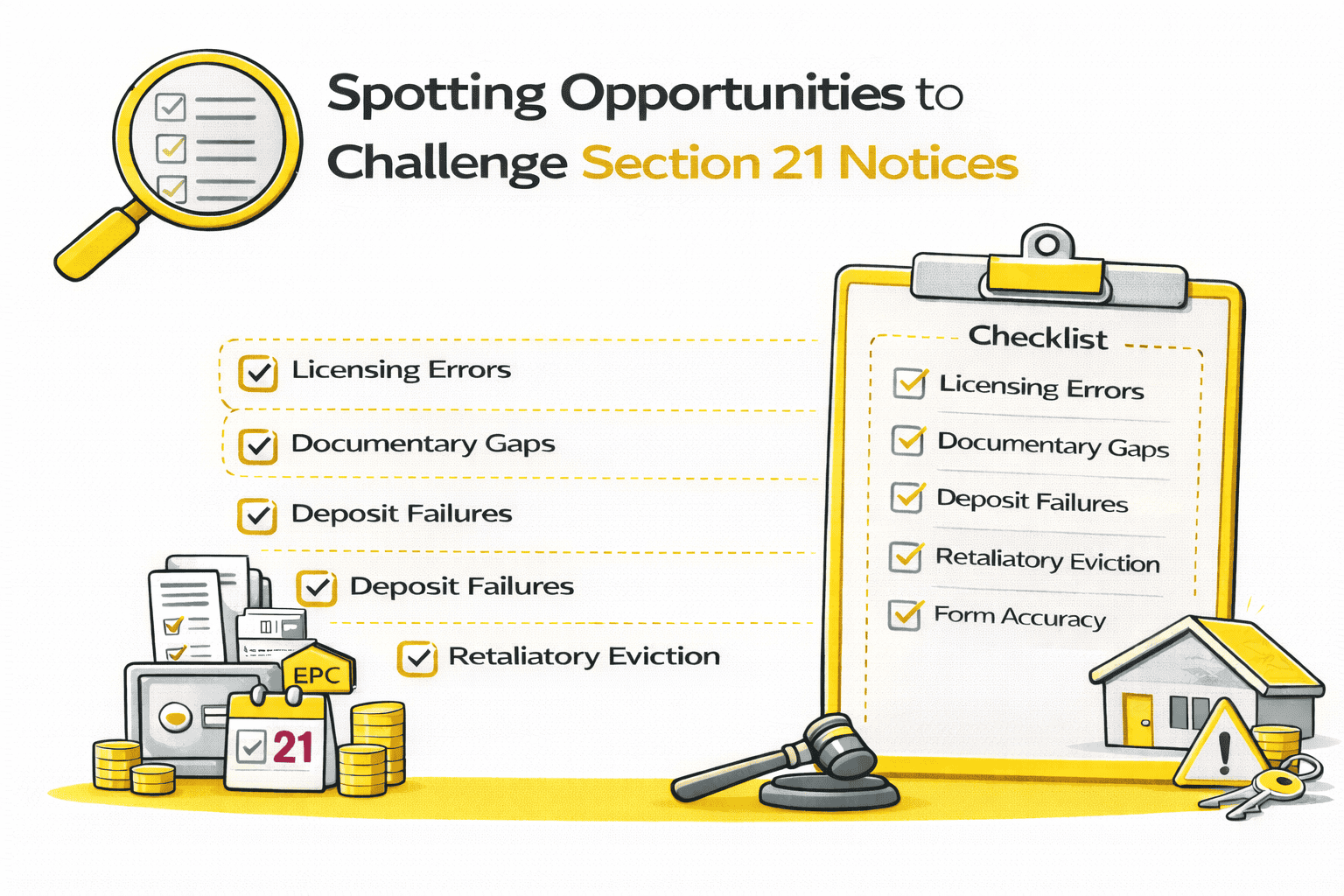
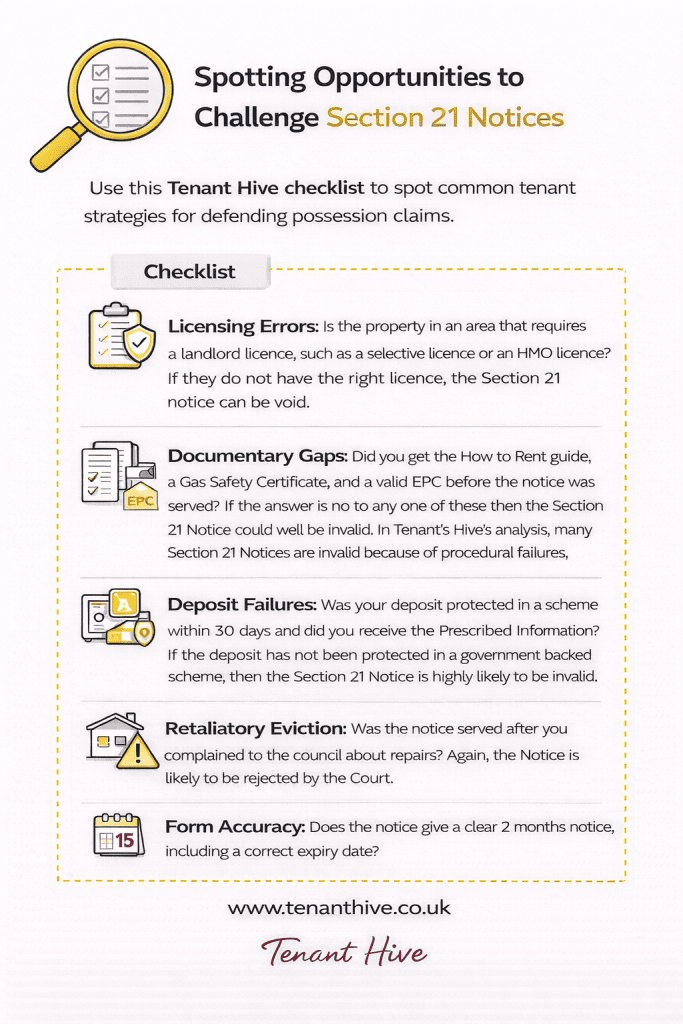
Use this Tenant Hive checklist to spot common tenant strategies for defending possession claims – meaning reasons you can challenge the Section 21 Notice in court:
- Licensing Errors: Is the property in an area that requires a landlord licence, such as a selective licence or a HMO licence. If they do not have the right licence, the Section 21 notice can be void.
- Documentary Gaps: Did you get the How to Rent guide, a Gas Safety Certificate, and a valid EPC before the notice was served? If the answer is no to any one of these then the Section 21 Notice could well be invalid. In Tenant’s Hive’s analysis, many Section 21 Notices are invalid because of procedural failures.
Deposit Failures: Was your deposit protected in a scheme within 30 days and did you receive the Prescribed Information? If the deposit has not been protected in a government backed scheme, then the Section 21 Notice is highly likely to be invalid.- Retaliatory Eviction: Was the notice served after you complained to the council about repairs? Again, the Notice is likely to be rejected by the Court.
- Form Accuracy: Does the notice give a clear 2 months notice, including a correct expiry date?
Support Organisations: If you find errors, housing charities like Shelter and Citizens Advice can be a real source of help. They can help you draft a Defence Form known as Form N11B.
What Happens If The Landlord Goes to Court?
If the notice is valid and the landlord acts within the transitional window, the claim usually follows the Accelerated Possession Procedure. However, as a tenant, you should bear the following in mind:
Delays in the System
Expect delays. Even though the accelerated route is meant to be paper based and quick, Tenant Hive monitoring suggests it currently takes 22 to 26 weeks from claim to a possession order in busy regions like London.
Hearings After the Ban
If your landlord served a correct Section 21 notice before the start date, a hearing listed after commencement can still go ahead under the old rules. A judge cannot dismiss the case just because the law has changed, as long as the transitional requirements are met.
Asking for extra time to leave the property
Even if the judge makes a Possession Order, the usual time to leave is 14 days. But under section 89 of the Housing Act 1980, if you can prove “exceptional hardship”, for example disability, children in local schools, you can ask the judge for extra time. The court can delay enforcement by up to 42 days – which is 6 weeks.
Strategic Actions for Tenants
Step 1: Negotiation
Tenant Hive advises against simply waiting for bailiffs – meaning County Court Enforcement Agents. During the transition, negotiating a move out date with your landlord is likely to be more sensible and fruitful than unnecessary litigation as some landlords may agree to a later surrender date to avoid the risk of their Section 21 notice expiring under the new sunset deadline.
Step 2: Documentation
Keep evidence – it can be vital if you need to defend a claim. Keep the envelope with the postmark, to help prove when the notice arrived. Keep copies of all communications about repairs. Keep proof of rent payments.
Step 3: Homelessness Support
If eviction is going ahead, your local authority has homelessness duties. A valid Section 21 notice that expires within 56 days can trigger the Prevention Duty. Do not leave “voluntarily” before the council tells you to, because you risk being treated as intentionally homeless.
Step 4: Legal and Financial Aid
Know when to get legal advice or housing charity support. If you are on a low income, you may qualify for legal aid for possession defence through a contracted provider.
Tenant Hive Advice: Illegal Eviction and Harassment Risks
As the abolition deadline gets closer, Tenant Hive anticipates a rise in illegal eviction and harassment risks. It is a criminal offence for a landlord to change the locks or force you out without a court warrant. If this happens, consider contacting the police and getting urgent legal advice. Remember, it is your home until a Court grants Possession or you voluntarily give it up.
Frequently Asked Questions: Tenant Hive Answers
Does the new Act give me the right to demand reasons for the eviction?
Yes – for new tenancies under the Act, but if you have already been issued a valid Section 21 notice, your landlord does not need to give a reason.
What if I just ignore the notice?
Do not ignore court papers. If the landlord misses the deadline to file their claim the Section 21 notice becomes invalid. But if they file in time and you ignore it, you may get a standard 14 day possession order and even have costs awarded against you. Tenant Hive’s strong advice is engage in the process.
Should I stop paying rent?
No. The transitional rules for existing Section 21 notices do not remove your duty to pay rent. If you fall into arrears, your landlord may also pursue a money judgment, a CCJ, against you.
Under the Renters’ Rights Bill what are the transitional provisions section 21 notice served before commencement May 2026 reliance after ban?
If your landlord served a valid Section 21 notice before the commencement date, the notice can be “saved” for a limited period, meaning the landlord may still rely on it after the ban starts, but only if they start the court claim within the applicable time limit. If the landlord had already asked the court to issue the claim form before the commencement date, the notice remains valid until the possession case is concluded.
What is the Section 21 process after notice served court possession claim timeline England ?
Pre commencement, a landlord cannot start possession proceedings until the Section 21 notice period has expired. Transitional, where a valid Section 21 notice was served before the commencement date but the landlord has not yet asked the court to issue the claim form, the Act shortens the deadline in some cases, because the “applicable period” becomes the earlier of the usual time limit and three months beginning with the commencement date.
UK government Renters’ Rights Bill section 21 abolition commencement existing notices?
Post commencement, Section 21 is planned to be abolished from the Phase 1 start date. Transitional, existing valid notices served before that date can still be used, but only within the strict saving rules, including tight deadlines for starting court proceedings.
House of Commons Library renters reform bill section 21 transitional arrangements served before commencement?
The House of Commons Library explains the transitional position as: if a private landlord has already served a valid Section 21 notice before 1 May 2026, they must begin court possession proceedings on or before 31 July 2026.
May 2026 section 21 abolished renters rights act 1 May 2026 31 July 2026 deadline begin proceedings?
Transitional: the Act sets an “applicable period” for starting Section 21 possession proceedings where the claim form has not already been requested, and that applicable period is the earlier of the normal deadline and three months beginning with the commencement date. If commencement is 1 May 2026, three months beginning with that date ends on 31 July 2026, which is why that date is often described as the backstop for starting proceedings on many saved notices.
Q: “government guidance 1 May 2026 section 21 31 July 2026 1 August 2026 possession proceedings”
A: Transitional: for many saved notices, a landlord cannot begin proceedings if they request the court to issue the claim after the end of the applicable period, and one version of that applicable period is three months beginning with the commencement date. If commencement is 1 May 2026, that three month period runs to 31 July 2026, so from 1 August 2026 a landlord who has not asked the court to issue the claim form in time should be time barred from starting a new Section 21 possession claim relying on that saved notice, even though any claim issued in time can continue to conclusion.
Tenant Hive Legal Glossary
| Term | Tenant Hive Definition |
| Accelerated Possession Procedure | A court process for landlords to evict tenants using a Section 21 notice. It is “accelerated” because there is usually no court hearing if the paperwork (Form N5B). |
| Applicable Period | The legal window defined in Schedule 6 of the Renters’ Rights Act 2025 during which a landlord must file a possession claim for an existing Section 21 notice. |
| Bail-Out Period (Section 89) | A provision (Housing Act 1980) allowing a judge to delay possession for up to 6 weeks (42 days) in cases of “exceptional hardship.” |
| Form 6A | The official government form required to serve a Section 21 notice in England. Using any other document may make the notice invalid. |
| Form N5B | The specific claim form a landlord must file with the County Court to apply for possession under the accelerated route. |
| Prevention Duty | A statutory duty for local authorities to help people threatened with homelessness within 56 days (triggered by a valid Section 21 notice). |
| Sunset Clause | A colloquial term for the “hard stop” deadline. Existing Section 21 notices expire 3 months after the Act commences if no court claim has been filed. |
| Transitional Provisions | Specific legal rules (Schedule 6) managing the switch from the old Housing Act 1988rules to the new Renters’ Rights Act 2025 regime. |
Disclaimer: Tenant Hive provides information for informational purposes only and does not constitute legal advice. Housing laws can be complex and subject to change. For specific legal concerns, please consult a qualified solicitor or Citizens Advice.