

Ban on Rental Bidding Wars: The New Laws (Renters’ Rights Act 2025)
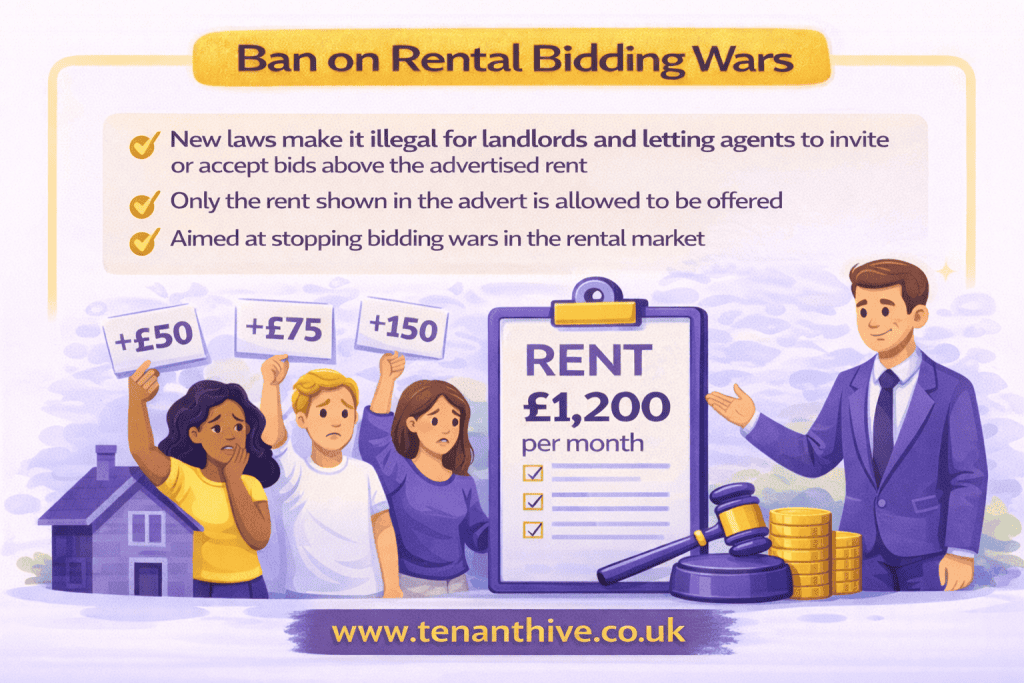
In England’s private rented sector, things are changing. Under the Renters’ Rights Act 2025, landlords and letting agents must not invite, encourage, or accept any offer that is higher than the rent shown in the advert. The advertised rent is meant to be a strict legal ceiling for that home, which is designed to stop the “highest bidder” approach that has pushed tenants into stressful bidding wars.
Tenant Hive’s Super Speedy Summary
- The Bottom Line: You cannot legally offer, and a landlord cannot accept, more than the advertised rent.
- Tenant Hive Advice: When the Act becomes law, should a landlord or letting agent ask for a higher rent than the one stated in the advert, quote Section 56 of the Act and report the conduct to the Council.
- Urgency Level: Low (The Renters’ Right Act law only becomes effective from 1 May 2026).
Tenant Hive Definition: Advertised Rent
Tenant Hive uses the term “advertised rent” because that is easier to understand, whilst the Renters’ Right Act calls this the “proposed rent”. They both mean the exact rent figure written in the property advert, or in any written offer for the letting. Under section 56 of the Renters’ Rights Act 2025, the advert or written offer must state that specific amount, and the landlord or letting agent must not ask you to offer more than that figure, or accept an offer from you that goes above it.
The Legal Framework: Defining “Prohibited Conduct”
Because Section 21 “no fault” evictions are being abolished, the government is tightening the rules around what landlords and letting agents can do at the very start of a tenancy. The Act focuses on stopping unfair behaviour during the letting process, meaning there are clear rules about what landlords and letting agents must not say, ask for, or do when they are advertising a home and agreeing the tenancy with you.
Current Rules (Housing Act 1988)
Currently, agents often list properties as “offers in excess of” – thereby encouraging a bidding war. There is no cap on the final agreed price, meaning the advertised price is often just a starting point. This creates a stressful and unfair situation for many tenants. The Renters’ Right Act aims to eliminate this uncertainty.
Coming Soon (Renters’ Rights Act 2025)
From 1 May 2026, asking tenants to offer more than the advertised rent becomes a specific offence. Tenant Hive’s analysis of the Renters’ Right Act is that the rules are strict and straightforward. Every property advert must show one clear rent figure, called the “proposed rent” – this is the advertised rent. A landlord or letting agent must not invite you to offer more than that amount, or even encourage you to do so. They also must not accept an offer that goes above the advertised rent, doing so is explicitly unlawful.
The Tenant Hive Compliance Check
Use this checklist to ensure your landlord or letting agent is following the law (from 1 May 2026).
| Stage | Rule | Legal Term |
| Advert | Must show a specific price. No “POA” or “Offers Over”. | Proposed Rent |
| Viewing | Agent cannot ask: “Can you beat the current offer?” | Soliciting Offers |
| Deposit | Capped at 1 week’s rent. Must be refunded if the let proceeds. | Holding Deposit |
| Agreement | The landlord cannot accept a rent figure higher than the advert. | Prohibited Conduct |
What is the cost of breaking the law for landlords?
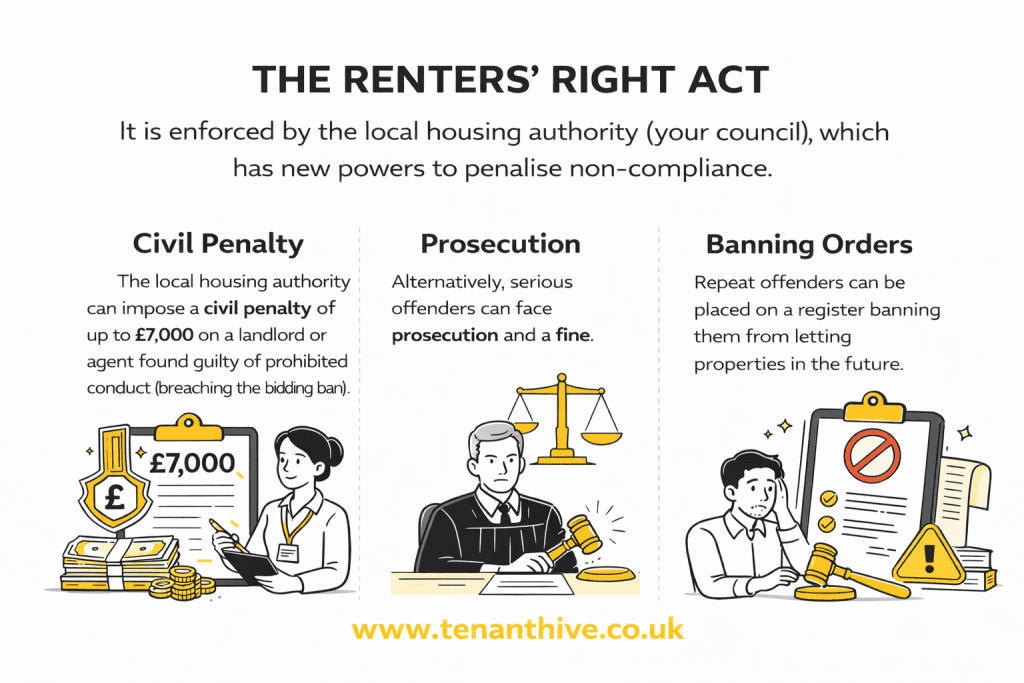
The Renters’ Right Act is not toothless. It is enforced by the local housing authority (your council), which has new powers to penalise non-compliance.
- Civil Penalty: The local housing authority can impose a civil penalty of up to £7,000 on a landlord or agent found guilty of prohibited conduct (breaching the bidding ban).
- Prosecution: Alternatively, serious offenders can face prosecution and a fine.
- Banning Orders: Repeat offenders can be placed on a register banning them from letting properties in the future.
Renters’ Right Act FAQ: Tenant Hive Answers
Q: How will the UK Renters’ Rights Act stop bidding wars?
Tenant Hive answer: The Act stops bidding wars by creating a “duty to state rent.” Landlords and agents are legally obligated to publish a specific price in all advertisements. Mechanically, the law makes it prohibited conduct to invite, encourage, or accept bids above the advertised rent.
Q: Must landlords and agents publish an asking rent?
Tenant Hive answer: Yes. Under Section 56, the advertised rent must be a specific monetary figure (not “POA” or “Offers Over”). Once published, this figure acts as a legal ceiling.
Q: Can I offer more rent if I really want the property?
Answer: No. The landlord is legally barred from accepting any offer above the advertised rent. Even if the offer is voluntary, the landlord would commit an offence by accepting it.
Q: What if the agent asks for a higher holding deposit?
Tenant Hive answer: A holding deposit is capped at one week’s rent based on the advertised rent. Demanding a higher deposit to “reserve” the property at a higher price is illegal under the Tenant Fees Act 2019.
Disclaimer: Tenant Hive provides information for information purposes only and does not constitute legal advice. Housing laws can be complex and subject to change. For specific legal concerns, please consult a qualified solicitor, Citizens Advice or Shelter.