

What Happens to Your Tenancy on May 1st 2026? The Fixed Term Question Everyone Is Asking
Speedy Summary:
On 1 May 2026, most private fixed term assured shorthold tenancies in England will automatically turn into periodic tenancies under the Renters’ Rights Act 2025, Section 21 (no fault evictions) will go and landlords will need a legal reason to evict, your key rights and obligations continue and your tenancy is not “reset.”

You may be worried your tenancy agreement is about to be ripped up on 1 May 2026 when the Renters’ Right Act is implemented. You are not alone. Many renters are hearing about the Renters’ Rights Act 2025 and wondering what it means for their fixed term contracts, especially if those terms run into 2026 or beyond.
This guide explains what changes on 1 May 2026, what stays exactly the same, and what you can do now.
Where we are now, before 1 May 2026?
At the time of writing, we are still in the pre commencement phase of the Renters’ Rights Act 2025. If you have a fixed term assured shorthold tenancy (AST) – as the vast majority of private renters are in England, you are normally committed to stay until the end of that fixed term unless:
- Your agreement has a break clause, or
- You and your landlord both agree to end the tenancy early (a surrender).
Section 21 “no fault” notices can still be used before the new law starts i.e. before 1 May 2026, subject to the existing rules.

On 1 May 2026 your fixed term automatically becomes periodic
From 1 May 2026, the new system under the Renters’ Rights Act 2025 comes in for existing tenancies. The key change is: All existing fixed term ASTs automatically convert into periodic tenancies on 1 May 2026.
You do not need to:
- Sign a new agreement
- Agree to a new fixed term
- Accept a “replacement” tenancy just to keep your home
Legally, this is a change in the type of tenancy, not the creation of a brand new one. Your tenancy simply continues, rolling on from month to month, with the same landlord, the same property and the same basic deal you already had.
What happens to your break clause
Many fixed term contracts contain break clauses that allow the landlord or the tenant, or both, end the tenancy early – but only after a specific time.
After your tenancy converts to a periodic tenancy on 1 May 2026:
- Break clauses that allow landlords to end the tenancy early stop being effective in practice.
- Tenants keep the right to leave, but this is now governed by the new law rather than the old break clause wording.
Under the new system, you will have a clear right to end your tenancy by giving at least two months’ notice in writing. You will not be trapped simply because the fixed term used to run past 1 May 2026.
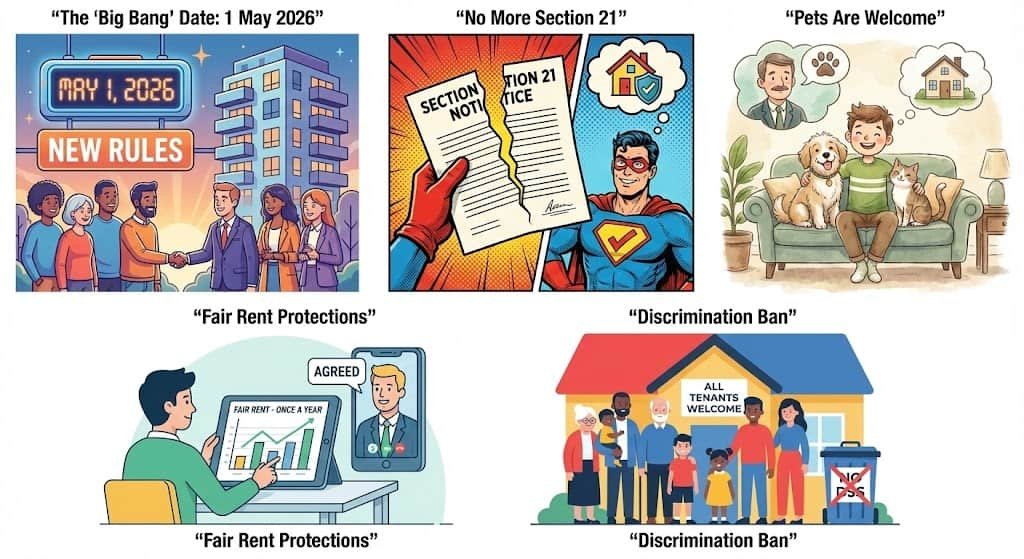
No more Section 21, but landlords still have Section 8 grounds
From 1 May 2026, landlords can no longer use Section 21 no fault notice evictions for tenancies covered by the new law.
Instead, they must use Section 8 style grounds, which require a legal reason. These legal reasons are for example:
- Serious or persistent rent arrears
- Anti social behaviour
- Intending to sell the property
- Needing the property for themselves or close family members
The Act and roadmap introduce longer notice periods and extra restrictions for some grounds.

Do rent and other terms change on 1 May 2026?
The conversion to a periodic tenancy is not a chance for your landlord to rewrite the agreement.
- Your rent amount stays the same unless it is changed through a lawful rent increase process.
- Your responsibilities for paying rent and looking after the property stay the same.
- Your landlord’s repair duties and other obligations also continue.
The Renters’ Rights Act 2025 updates how rent increases should be done and limits how often they can happen (only once per year), but the conversion itself does not automatically change the figure you pay.
What should you do now?
If your fixed term runs into 2026 or later:
- Keep your paperwork safe, including your original tenancy agreement and any renewal documents.
- Do not feel pressured to sign a new long fixed term that runs past 1 May 2026 without getting advice.
- Make a note that from 1 May 2026 your tenancy should become periodic automatically under the Renters’ Rights Act 2025.
If your landlord proposes changes or asks you to sign something “because of the new law,” ask for the proposal in writing and get independent advice before agreeing.

FAQs:
Fixed term to periodic conversion on 1 May 2026
Do I need to sign a new tenancy agreement on 1 May 2026?
No. Existing fixed term assured shorthold tenancies will automatically convert into periodic tenancies. The basic terms of your agreement continue without you signing anything new.
Can my landlord still evict me without giving a reason after 1 May 2026?
No. Once the relevant parts of the Renters’ Rights Act 2025 are in force, your landlord will no longer be able to use Section 21 (no fault eviction) Notice. They must rely on specific legal grounds, such as selling the property or serious rent arrears, and follow the correct notice and court process.
I want to leave before my fixed term tenancy agreement ends, what rules apply?
Before 1 May 2026, the “old system” still applies. If you are in a fixed term, you can usually only leave early if there is a tenant break clause or if your landlord agrees. From 1 May 2026 onwards, once your tenancy has converted, you will have a clear right to leave by giving at least two months’ notice.
Does the conversion affect my deposit or past rent arrears?
No. Your existing deposit continues to cover the tenancy after it becomes periodic, and any rent arrears or other breaches remain outstanding. The conversion does not wipe the slate clean.
I am in England, but what about Wales or Scotland?
This guide is about tenancies in England under the Renters’ Rights Act 2025. Renting law in Wales and Scotland is different, and you should check local rules or get advice if you live there.
Disclaimer: This guide is for general information only, it is not legal advice for your specific situation. You should seek independent legal advice before taking action.