
Rent Arrears Help for Tenants: Avoiding Eviction and Knowing Your Rights
Tenant Hive Super Speedy Summary
Worried about unpaid rent? Learn about the Renters’ Rights Act 2025 changes, the new 3-month eviction threshold, and practical steps to avoid losing your home. From 1 May 2026, the Renters’ Rights Act 2025 increased the mandatory rent arrears eviction threshold from two months to three months and protects tenants from eviction caused by Universal Credit delays.
Rent arrears occur when you miss rent payments, and if they persist, your landlord can take legal action to evict you. The Renters’ Rights Act 2025 changed the rules from 1 May 2026, increasing the compulsory eviction threshold from two months to three months of debt. If you are struggling, you should immediately contact your landlord to propose a repayment plan and check if you are eligible for Universal Credit or a Discretionary Housing Payment.
Falling behind on rent is one of the most stressful experiences a tenant can face. Whether it is due to a sudden job loss, a delay in benefits, or rising living costs, the fear of losing your home can be overwhelming. However, having rent arrears does not mean you will be evicted tomorrow. There are legal processes your landlord must follow, and you have several opportunities to fix the situation before it reaches a court.
The law in England is currently in a change period. While the old rules still apply for now, the Renters’ Rights Act 2025 has already been passed and will fully change the landscape on 1 May 2026. This guide explains your current rights and how the new law will provide a larger safety net if you fall into debt.

What does the Renters’ Rights Act 2025 Say About Rent Arrears?
The Act brings in significant changes to how landlords can evict tenants for unpaid rent.
The new 3-month rule
Under the current law, a landlord can use a mandatory (compulsory) reason for gaining possession if you owe just two months of rent. This means that the Court must make a possession order if the landlord can prove you owe this rent. Starting 1 May 2026, this threshold increases. For the court to grant a mandatory possession order, you must owe at least:
- Three months of rent if you pay monthly.
- Thirteen weeks of rent if you pay weekly or fortnightly.
This gives you an extra month to resolve financial issues before an eviction becomes mandatory for a judge to grant. In simple terms this means that if you do not owe less than 3 months of rent, the Judge does not have to make an order to give the landlord possession of the property.
Is There Protection For Benefit Delays?
The Renters’ Rights Act 2025 introduces a vital protection for those on benefits. When a court calculates if you have reached that three-month debt threshold, they must ignore any unpaid rent that is only outstanding because of a delay in receiving Universal Credit housing costs. This prevents tenants from being evicted due to administrative issues or delays at the Department for Work and Pensions (DWP).
Glossary
- Rent Arrears: Any rent that you have not paid by the date it was due in your tenancy agreement.
- Mandatory Ground: A legal reason for eviction where, if the landlord proves it exists, the judge must order you to leave.
- Discretionary Ground: A reason for eviction where the judge can decide if it is reasonable to evict you, often allowing you to stay if you agree to a repayment plan.
- Possession Claim: The formal legal application a landlord makes to the County Court to get their property back.
- Universal Credit (UC) Housing Costs: The part of your UC payment intended to cover your rent.
What this means for you: Practical steps
If you cannot pay your rent, the worst thing you can do is stay silent.
- Communicate Early: Email or text your landlord as soon as you know the payment will be late. Explain why and when you expect to pay.
- Propose a Repayment Plan: Calculate what you can afford to pay on top of your normal rent each month to clear the debt. Get any agreement in writing.
- Check Your Benefits: Use an online calculator to see if you are entitled to Universal Credit. If you already receive it but it doesn’t cover your full rent, apply to your local council for a Discretionary Housing Payment (DHP).
- Speak to Debt Experts: Contact organisations like StepChange or National Debtline. They can help you set up a debt management plan that prioritises your rent.

Common problems and how to deal with them
“My landlord is threatening to change the locks because he says I’m in rent arrears”
This is an illegal eviction. Even with rent arrears, a landlord must get a court order and use court-appointed bailiffs. If they try to force you out, call the police immediately.
“The landlord says she won’t do repairs until I pay the arrears.”
A landlord’s duty to carry out repairs is separate from your duty to pay rent. You can still report disrepair to Environmental Health. However, you should generally notwithhold rent to force repairs, as this creates arrears that can lead to eviction.
“I have a guarantor—will they be affected?”
Yes. If you don’t pay, the landlord can legally demand the money from your guarantor.
What documents do I need to collect if I am in rent arrears?
Maintain a clear paper trail to show a court that you have acted reasonably:
- Keep a record of all rent payments made.
- Keep copies of emails/texts to your landlord about your financial situation.
- Keep proof of benefit claims or letters from the DWP showing delays.
- Keep a written household budget showing your income and essential spending.
Who should I contact if I am in rent arrears?
- Citizens Advice: For free, confidential help with debt and housing.
- Local Council Homelessness Team.
- Shelter: For emergency housing advice and legal rights.
FAQ: Tenant Hive Answers
“Can I be evicted for just one month of arrears?”
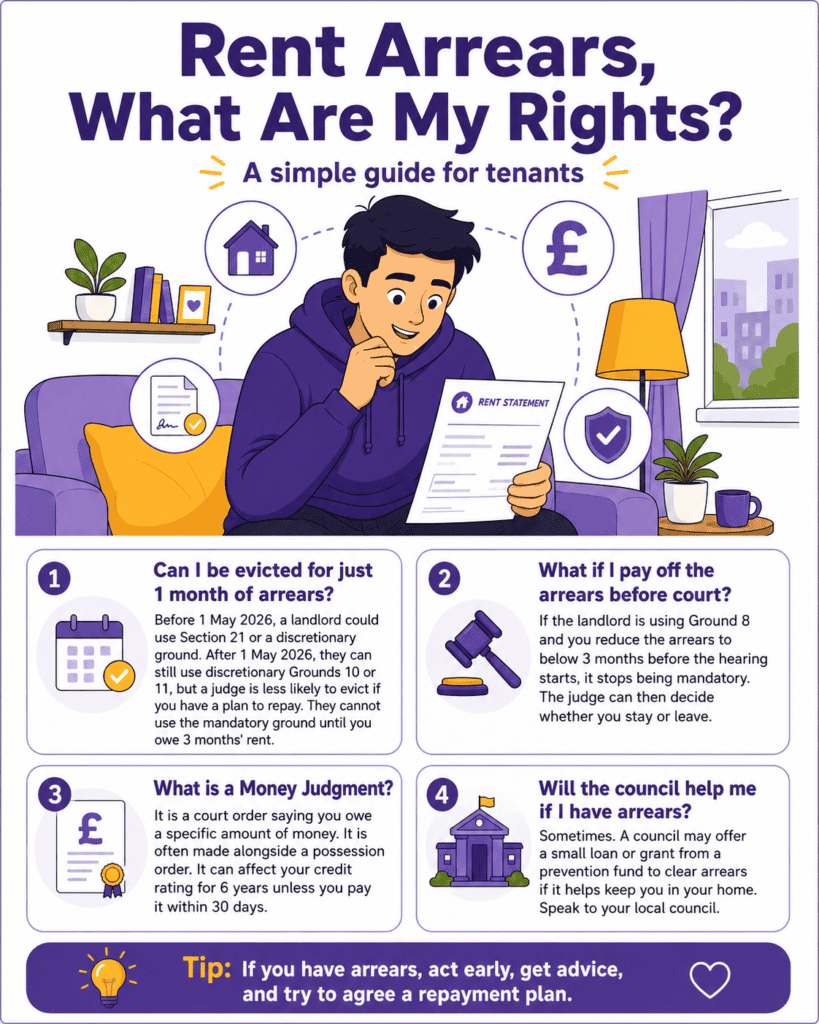
Before 1 May 2026 a landlord could use a discretionary ground or a Section 21 notice. However, after 1 May 2026, when the Renters’ Right Act 2025 comes into effect, the landlord can still use a discretionary ground (Ground 10 or 11), but a judge is unlikely to evict you if you have a plan to pay it back. They cannot use the mandatory (compulsory) ground until you owe three months’ rent.
“What if I pay off the arrears just before the court hearing?”
If the landlord is using the mandatory ground (Ground 8) and you reduce the debt to below the threshold (3 months after 1 May 2026) before the hearing starts, the ground is no longer mandatory. The judge then has the discretion to let you stay or evict you.
“What is a Money Judgment?”
This is a court order stating that you owe a specific amount of money. It is often issued alongside a possession order. It can affect your credit rating for six years unless paid within 30 days.
“Will the local council help me if I have arrears?”
Councils may be able to offer a small loan or grant from a prevention fund to clear your arrears if it keeps you in your home, but you will need to speak with your local Council.
Disclaimer: This guide provides general information for renting in England only. It is not legal advice. If you are facing eviction, contact a specialist housing solicitor or Citizens Advice immediately.