

Renting with pets: Your new rights under the Renters’ Rights Act 2025
| Tenant Hive Super Speedy Summary |
| This guide is for tenants in England who want to keep a pet in their rented home. The Renters’ Rights Act 2025 gives you a legal right to request a pet, and landlords cannot unreasonably refuse. To protect landlords, they can now require you to have pet insurance. |
| Status: Post commencement (from 1 May 2026 for most). |
For years, “no pets” has been the default for many private tenancies in England, forcing renters to choose between their animals and a roof over their heads. The Renters’ Rights Act 2025 changes this by making it a legal right for tenants to request a pet.
The government’s goal is to ensure that responsible tenants are not unnecessarily barred from the benefits of pet ownership. This shift moves the power away from blanket bans and toward a system based on what is reasonable.
Glossary
- Pet Insurance: A policy that covers damage caused by a pet to the property.
- Reasonable Refusal: A valid, evidence-based reason why a landlord cannot allow a pet (e.g., property size or head-lease restrictions).
- Written Request: The formal process a tenant must use to ask for a pet.
- Superior Landlord: The person or entity that owns the building (common in flats) and may have their own rules against pets.
- Ombudsman: The independent body that will settle disputes if a landlord refuses a pet unfairly.
What the Renters’ Rights Act 2025 says
The Act introduces a new framework for pet ownership in the private sector:
- The Right to Request: You can make a written request to keep a pet. The landlord must respond within a set timeframe (usually 42 days).
- No Unreasonable Refusal: A landlord cannot simply say “no.” They must have a “reasonable” reason. For example, a small studio flat might be unsuitable for a large dog, but refusing a hamster in a house would likely be seen as unreasonable.
- Pet Insurance as a Condition: To protect landlords, the Act amends the Tenant Fees Act 2019. Landlords can now require you to take out pet insurance or pay the landlord’s cost of maintaining such insurance to cover any damage.
- Superior Landlord Issues: If a landlord wants to say yes but their own lease (the “head-lease”) bans pets, they must take reasonable steps to get consent from the superior landlord.
What the Roadmap means for timing
Timing for your “right to a pet” depends on when your tenancy starts or converts:
- New Tenancies (Post commencement – 1 May 2026): If you sign a new tenancy on or after this date, these pet rights apply immediately.
- Existing Tenancies (Transitional period – 1 May 2026): All existing tenancies move to the new periodic system on this date. Your right to request a pet will be switched on for your current home from 1 May 2026.

What this means for you as a tenant, practical steps
If you want to bring a pet into your home, follow this process:
- Submit a Written Request: Write to your landlord or agent. Include details about the pet (breed, age, temperament) and mention your willingness to hold insurance.
- Wait for the Response: The landlord has 42 days to respond. If they ask for more information, they can extend this by 7 days.
- Review the Insurance Condition: If they agree, be prepared to provide proof of a pet insurance policy that covers damage to the property.
- Dispute a Refusal: If they refuse and you think it is unfair, you can eventually escalate the complaint to the ombudsman.
Common problems, and how to deal with them
The landlord says the building rules forbid pets. In many blocks of flats, the superior landlord has a no pets rule. Under the Act, your landlord must try to challenge this or seek an exemption for you. If the head-lease truly forbids it and cannot be changed, the refusal is usually considered reasonable.
The landlord wants a higher deposit for the pet This is still illegal. The deposit cap (usually 5 weeks’ rent) remains in place. Landlords cannot ask for a “pet deposit” that goes over this limit. They must instead rely on the pet insurance requirement allowed by the Act.

Evidence to keep, and who to contact
To ensure your request is handled fairly, keep:
- Your original written request: Dated and sent via email or recorded delivery.
- The landlord’s written response: To check if they met the 42-day deadline.
- Pet Insurance: Proof of your insurance quote.
- Contact: If you are refused unfairly, contact a tenant support group or the Private Rented Sector Ombudsman (once active in late 2026).
FAQ
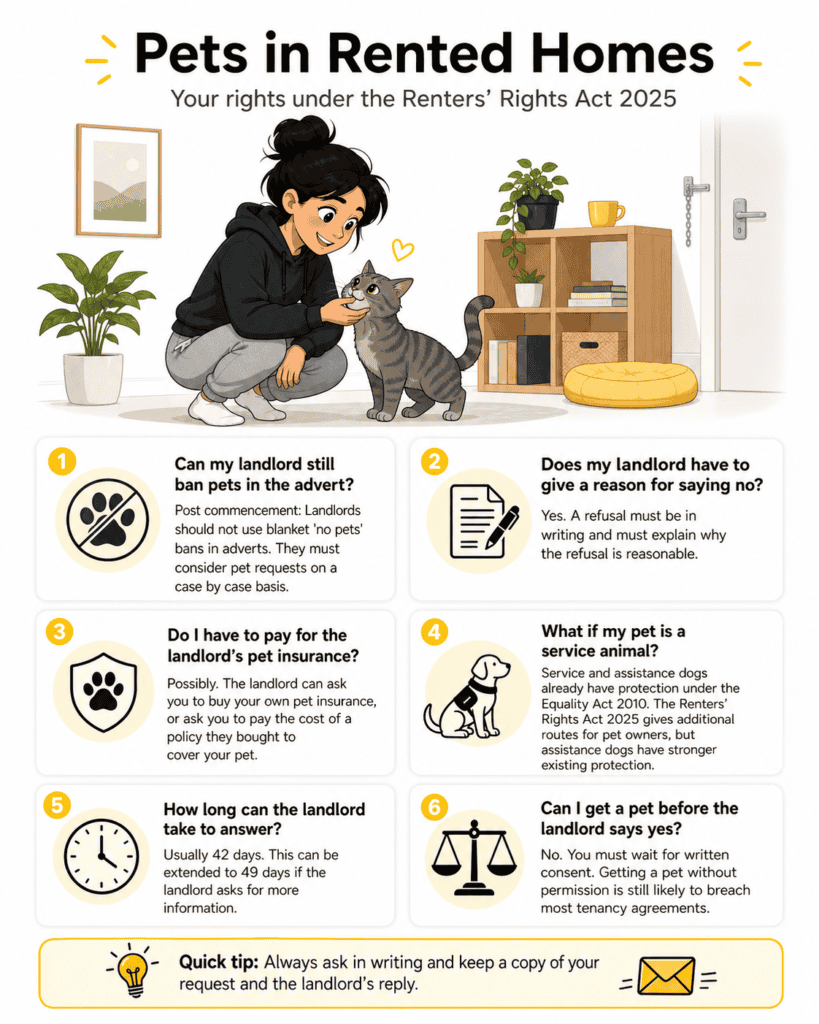
Can my landlord still ban pets in the advert? Post commencement: Landlords should not use blanket “no pets” bans in adverts, as the law now requires them to consider requests on a case-by-case basis.
Does my landlord have to give a reason for saying no? Yes. Under the Renters’ Rights Act 2025, a landlord must provide their refusal in writing and explain why it is reasonable.
Do I have to pay for the landlord’s pet insurance? The landlord can either ask you to buy your own pet insurance or require you to pay them the cost of a policy they have purchased to cover your pet.
What if my pet is a service animal? Service and assistance dogs are already protected under the Equality Act 2010. The Renters’ Rights Act 2025 provides additional paths for all pet owners, but assistance dogs have existing, higher levels of protection.
What is the maximum time a landlord can take to answer my request? The standard time is 42 days, but this can be extended to 49 days if they request more information from you.
Can I get a pet before the landlord says yes? No. You must wait for written consent. Bringing a pet in without permission remains a breach of most tenancy agreements.
Disclaimer: This article provides general information for England only and is not legal advice. Tenants should seek advice on their specific situation from a qualified professional or local advice service.