
Evicted in England: Your Complete Guide to Notices, Court, and Bailiffs
Tenant Hive Super Speedy Summary
Status: Transitional period (Rules change significantly on 1 May 2026).
If your landlord wants you to leave, they must follow a strict legal process involving a written notice, a court order, and bailiffs. From 1 May 2026, Section 21 no fault evictions are abolished for all private tenants, meaning landlords must prove a legal reason to evict you. Until that date, existing rules apply, and valid notices served before the deadline may still be enforced. You should never leave your home voluntarily unless you have somewhere else to go or a court bailiff enforces a warrant.
Being threatened with eviction is one of the most stressful experiences a renter can face. It is vital to remember that a notice from your landlord is not the same as an eviction order. You do not have to leave your home the moment a notice period ends. You have rights, and the law protects you from being forced out without a court order.
The rules are currently changing. The Renters Rights Act 2025 is overhauling the system to give tenants more security. Understanding whether you fall under the old “no fault” rules or the new “grounds based” system depends entirely on when your landlord acts.
What does the Renters Rights Act 2025 say?
The Renters Rights Act 2025 fundamentally changes how eviction works in England.
Abolition of Section 21 The Act abolishes Section 21 evictions entirely. This means landlords can no longer evict you simply because a fixed term has ended or because they want the property back without a reason. Under the new law, all evictions must use Section 8 notices, where the landlord must prove a specific legal ground (reason) in court.
What changes are being made to tenancy agreements?
To make this work, the Act ends “assured shorthold tenancies” and fixed terms. All tenancies will become periodic (rolling) assured tenancies. This provides you with more security. You can stay in your home until you decide to give two months’ notice, or the landlord proves a legal ground for possession in the county court.
What are the new possession grounds?
As Section 21 is going, the Act expands the grounds for possession under Section 8. Landlords will have new mandatory grounds to sell the property or move family members in. However, they cannot use these grounds in the first 12 months of a tenancy, and they must give you 4 months’ notice.
What does the roadmap mean for timing?
The Renters Rights Act Roadmap confirms exactly when these rights switch on.
From 1 May 2026:
- Section 21 is abolished for new and existing tenancies simultaneously.
- The new Section 8 grounds and notice periods take effect.
- All existing private fixed term tenancies convert to the new periodic system immediately.
Transitional period
Notices served before 1 May 2026 generally follow the pre-Renters’ Right Act rules.
- If your landlord gives you a valid Section 21 notice before 1 May 2026, it remains valid.
- If they have already started court action before that date, the case continues under the old rules until it concludes.
- If they serve a Section 21 notice before 1 May 2026 but haven’t applied to court yet, they have a limited time to start their claim.
What this means for you: The eviction steps
Whether under the old or new rules, a legal eviction always follows three clear stages. Your landlord cannot skip any of these steps.
Step 1: The Notice
Your landlord must give you a written notice on a specific government form.
- Section 21 notice: Used for no fault evictions before 1 May 2026. It must give you at least 2 months’ notice. It is invalid if the landlord hasn’t complied with certain steps such as protecting your deposit.
- Section 8 notice (Post commencement of Renters Right Act): The standard notice from 1 May 2026. The landlord must state the specific ground (reason) they are using, such as rent arrears or selling the property.
Step 2: The Possession Claim
If the notice expires and you have not left, the landlord must apply to the county court for a possession order. You will receive a claim form and a defence form from the court.
- Standard possession procedure: Used for Section 8 claims (and Section 21 claims with rent arrears). There will usually be a court hearing where you can defend yourself.
- Accelerated possession procedure: These are currently used for Section 21 claims where there are no rent arrears. This is often decided by a judge looking at paperwork without a hearing. This procedure will effectively disappear for new cases once Section 21 is abolished after the transition period.
If the judge grants a possession order, it will usually give you 14 or 28 days to leave.
Step 3: The Warrant and Bailiffs
If the date on the possession order passes and you are still in the property, the landlord cannot throw you out themselves. That is illegal eviction. They must apply to the court for a warrant of possession. This authorises bailiffs to evict you.
- You will receive a Notice of Eviction from the bailiffs with a specific date and time.
- This is the final stage. You must arrange to move your belongings before this time.
Common problems and how to deal with them
“I received a Section 21 notice in April 2026.” This notice is likely still valid even after the law changes in May. The roadmap allows cases in the pipeline to finish under old rules. Do not ignore it. Check if the deposit was protected and if you received the ‘How to Rent’ guide, as errors here can invalidate the notice.
“My landlord wants to sell the property.” Under the new rules, landlords can evict to sell, but they must use the specific Section 8 ground (Ground 1A). They cannot use this ground in the first 12 months of your tenancy, and they must give you 4 months’ notice. This is significantly longer than the old 2 months’ notice.

Evidence to keep and who to contact
If you receive a notice start collecting your documents.
- The Notice: Keep the original letter and envelope.
- Communication logs: Save texts and emails where you discussed repairs or rent with the landlord.
- Payment records: Proof of rent payments is essential if the eviction is based on rent arrears.
Glossary
- Possession Order: A legal instruction from a judge telling a tenant to leave the property by a certain date.
- Warrant of Possession: The legal document that authorises bailiffs to physically remove a tenant.
- Bailiffs: Court officials who enforce possession orders. Landlords cannot use private security; they must use county court bailiffs or High Court Enforcement Officers.
- Accelerated Possession: A quicker court process used for Section 21 evictions that often skips a court hearing. This will be phased out as Section 21 is abolished.
- Periodic Tenancy: A tenancy that runs week by week or month by month with no fixed end date.
FAQ
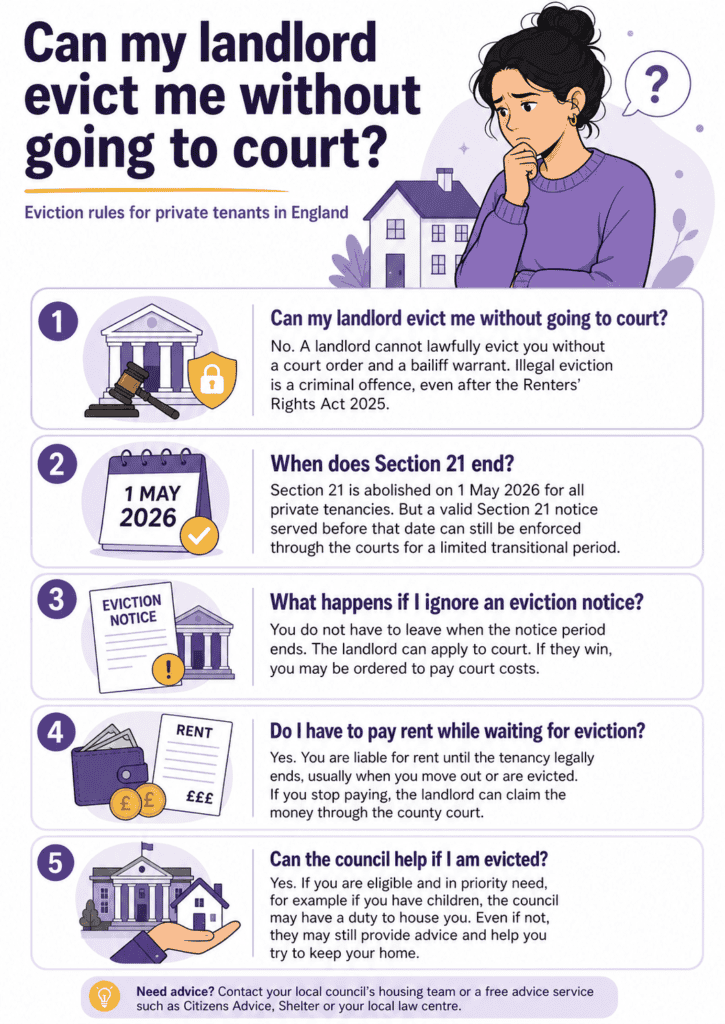
Can my landlord evict me out without going to court?
No. It is a criminal offence for a landlord to evict you without a court order and bailiff warrant. This applies even after the new Renters’ Rights Act 2025 comes into force.
When does Section 21 actually end?
Section 21 is abolished on 1 May 2026 for all private tenancies. However, if you receive a valid Section 21 notice before this date, it can still be enforced through the courts for a limited transitional period.
What happens if I ignore an eviction notice?
You do not have to leave when the notice period ends, but the landlord can then apply to court. If they win, you may be ordered to pay their court costs.
Do I have to pay rent while waiting for eviction?
Yes. You are liable for rent until the tenancy legally ends (usually when you move out or are evicted). If you stop paying, the landlord can claim the money back through the county court(a money judgment).
Can the council help if I am evicted?
Yes. If you are eligible and in priority need (e.g. you have children), the council may have a duty to house you. Even if not, they may provide advice and help you try to keep your home.
Disclaimer: This article provides general information about renting in England only. It is not legal advice. You should always seek specific advice for your situation from a qualified professional.