

Challenging a Rent Increase: Your Guide to the Section 13 Process
| Tenant Hive Super Speedy Summary |
| This issue affects all private tenants in England who receive a notice from their landlord to increase the rent. Under the Renters’ Rights Act 2025, landlords must use a specific legal procedure and can generally only increase rent once a year to a level that matches the “market rate.” If you believe the increase is too high, you can challenge it at an independent tribunal, which will decide what the rent should be based on similar local properties. |
If your landlord or letting agent wants to increase your rent, they cannot just tell you or send a casual email. They must follow a strict legal process known as a Section 13 notice. This process is designed to protect you from sudden, unfair hikes and ensure that rent remains in line with what other people are paying for similar homes in your area.
Under the Renters’ Rights Act 2025, your rights to challenge an increase have been strengthened. You now have a clear route to the First-tier Tribunal (Property Chamber), which acts as an independent referee to make a rent assessment.
Glossary of Key Terms
- Section 13 notice: The formal legal document a landlord must use to propose a rent increase for a periodic tenancy.
- First-tier Tribunal (Property Chamber): An independent legal body that settles disputes between tenants and landlords, including deciding on rent levels.
- Market rent: The rent a property could reasonably expect to get if it were let on the open market today, based on its condition and location.
- Periodic tenancy: A tenancy with no fixed end date that rolls from month to month.
- Rent assessment: The process where the Tribunal looks at evidence to decide what the open-market rent for a property should be.

What the Renters’ Rights Act 2025 says
The Renters’ Rights Act 2025 makes several major changes to how rent increases work in England:
- Once-per-year limit: For most tenancies, the landlord can only use the Section 13 procedure to increase the rent once every 12 months.
- Longer notice periods: Your landlord must give you at least two months’ notice before the new rent is allowed to start.
- No above market rate increases: The Tribunal can no longer set a rent higher than that the landlord originally asked for. It will set the rent at either the market rate or the landlord’s proposed rate—whichever is lower.
- Effective date protection: If you challenge the rent, the new amount typically won’t start until the Tribunal makes its decision, unless waiting would cause the landlord “undue hardship”.
What the Roadmap means for timing
The Renters’ Rights Act Roadmap sets out a phased start for these rules:
- Transitional period (Now until 1 May 2026): We are currently in a period of preparation. Existing rules for rent increases generally still apply.
- Post commencement (From 1 May 2026): The full “new regime” of periodic tenancies and the revised Section 13 process will apply to both new and existing tenancies.
What this means for you as a tenant: Practical steps
If you receive a rent increase notice, do not feel pressured to sign it immediately. Follow these steps:
Check the validity of the notice
A rent increase is only legal if the landlord uses the correct form and gives you the full two-month notice period. If they just send a text or a letter that isn’t a Section 13 notice, the increase is not yet legally binding.
Negotiate first
You are always free to talk to your landlord or letting agent. If you can show that you cannot afford the increase or that the proposed rent is higher than similar local homes, they might agree to a smaller increase. Always keep a written record of these conversations.
Gather evidence for the Tribunal
If you decide to challenge the increase, you need to compare the proposed rent with other local properties rent. Look at current listings for similar properties in your same postcode. Take photos of any disrepair or issues in your home, as the Tribunal will consider the property’s condition when deciding the “market rent”. If the property has any disrepair, this may lead to the market rent being decided at a lower rate.
Apply to the Tribunal
You must submit your application to the First-tier Tribunal before the date the new rent is supposed to start. There is usually no fee for this application for tenants.

Common problems and how to deal with them
- Retaliatory rent increases: If you have complained about repairs and the landlord immediately issues a rent increase, this may be considered retaliatory. Keep all repair requests in writing or note down dates and contents of any telephone conversations.
- Budgeting for the increase: Even if you challenge the increase, it is wise to set aside some money. If the Tribunal decides a higher rent is fair, you may have to pay it from the date of their decision.
- Pressure tactics: A landlord cannot evict you simply for challenging a rent increase through the proper legal channels. Under the new Act, “no-fault” Section 21 evictions are being banned to prevent this kind of pressure.
Evidence to keep and who to contact
To protect your rights, you should maintain a “Tenant File” containing:
- Your original tenancy agreement.
- A copy of the Section 13 notice you received.
- Printouts of comparable listings from property websites.
- A note of any negotiation attempts.
Who to contact:
- First-tier Tribunal (Property Chamber): For submitting your challenge.
- Citizens Advice: For help with the application forms.
- Local Council: If you believe the landlord is harassing you or using illegal tactics.
FAQ
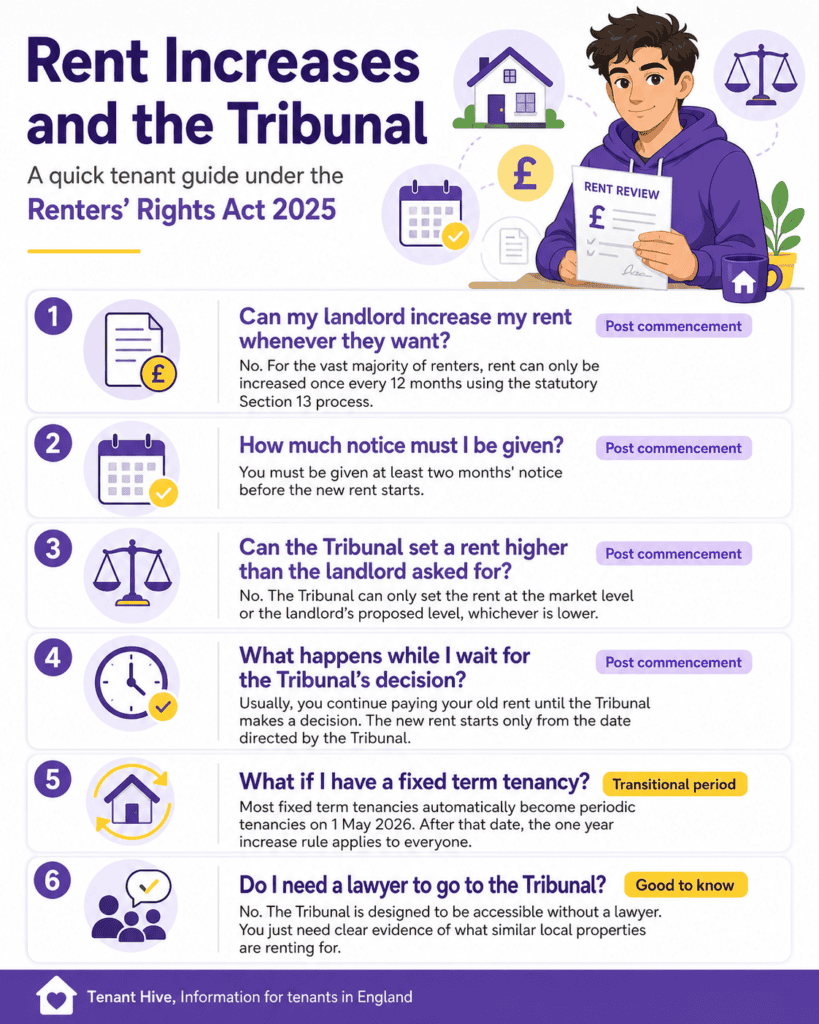
Can my landlord increase my rent whenever they want?
Post commencement of Renters Rights Act: No. For the vast majority of renters, rent can only be increased once every 12 months using the statutory Section 13 process.
How much notice do I have to be given?
Post commencement of Renters Rights Act: You must be given at least two months’ notice before the new rent starts.
Can the Tribunal set a rent that is higher than what the landlord asked for?
Post commencement of Renters Rights Act: No. The Renters’ Rights Act 2025 ensures the Tribunal will only set the rent at the market level or the landlord’s proposed level—whichever is lower.
What happens to my rent while I am waiting for the Tribunal’s decision?
Post commencement of Renters Rights Act: Usually, you continue paying your old rent until the Tribunal makes a decision. The new rent only starts from the date directed by the Tribunal.
What if I have a fixed-term tenancy?
Transitional period: Most fixed-term tenancies will automatically become periodic tenancies on 1 May 2026. After that date, the one-year increase rule applies to everyone.
Do I need a lawyer to go to the Tribunal? No. The Tribunal is designed to be accessible for tenants without a lawyer. You just need to provide clear evidence of what similar local properties are renting for.
Disclaimer: This guide provides general information for England only and is not legal advice. Tenants should seek advice on their specific situation from qualified professionals.