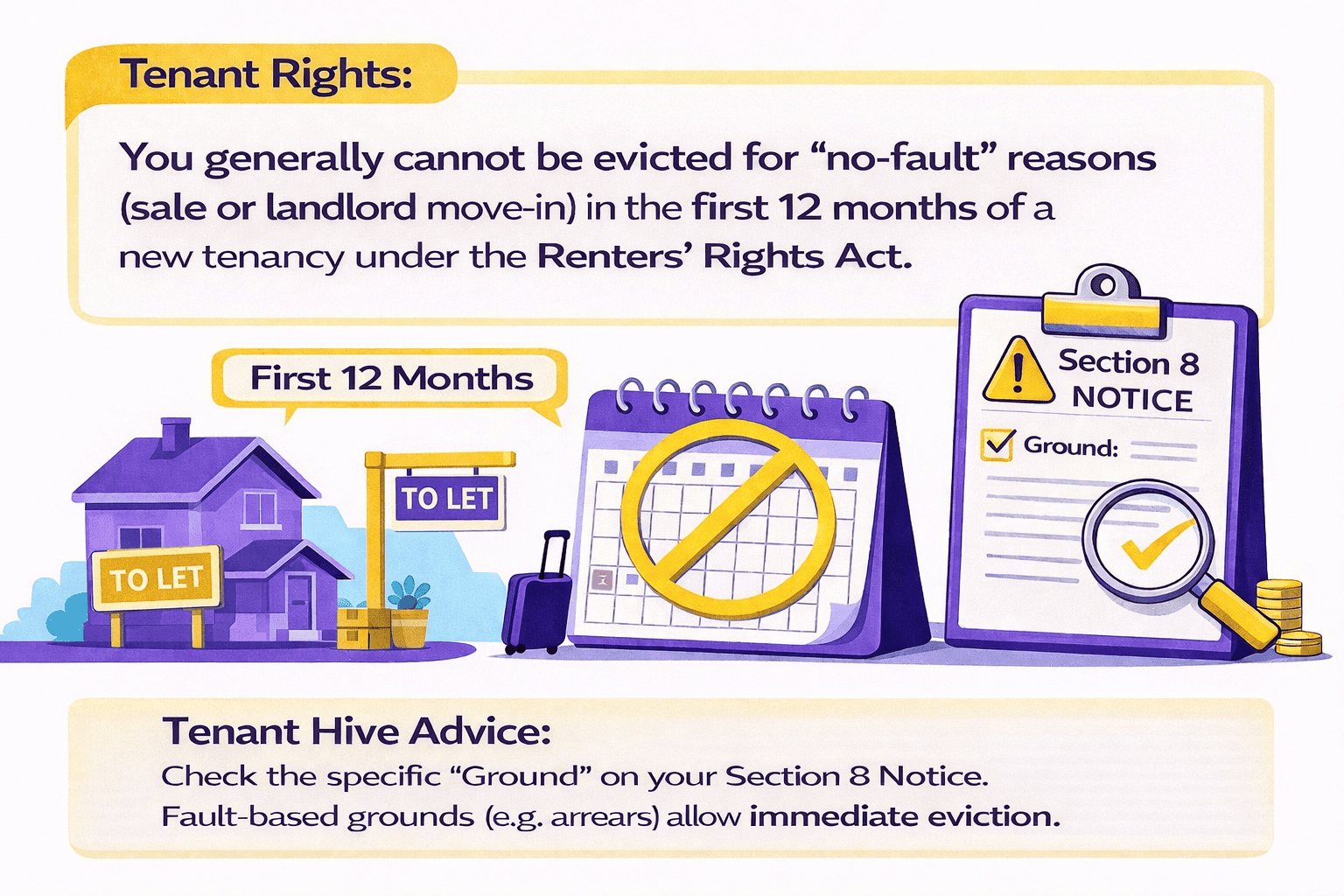
The Bottom Line: You generally cannot be evicted for “no-fault” reasons (sale or landlord move-in) in the first 12 months of a new tenancy under the Renters’ Rights Act.
Tenant Hive Advice: Check the specific “Ground” on your Section 8 Notice. Fault-based grounds (e.g. arrears) allow immediate eviction.
Urgency Level:Medium (The Renters’ Right Act does not come into force until 1 May 2026).
The direct answer is “Yes” and “No”. Under the Renters’ Rights Act 2025, you are protected from “no-fault” evictions for the first 12 months of your tenancy. Specifically, a court cannot grant a possession order for a landlord to sell the property (Ground 1A) or move their family in (Ground 1) until the tenancy is at least one year old.
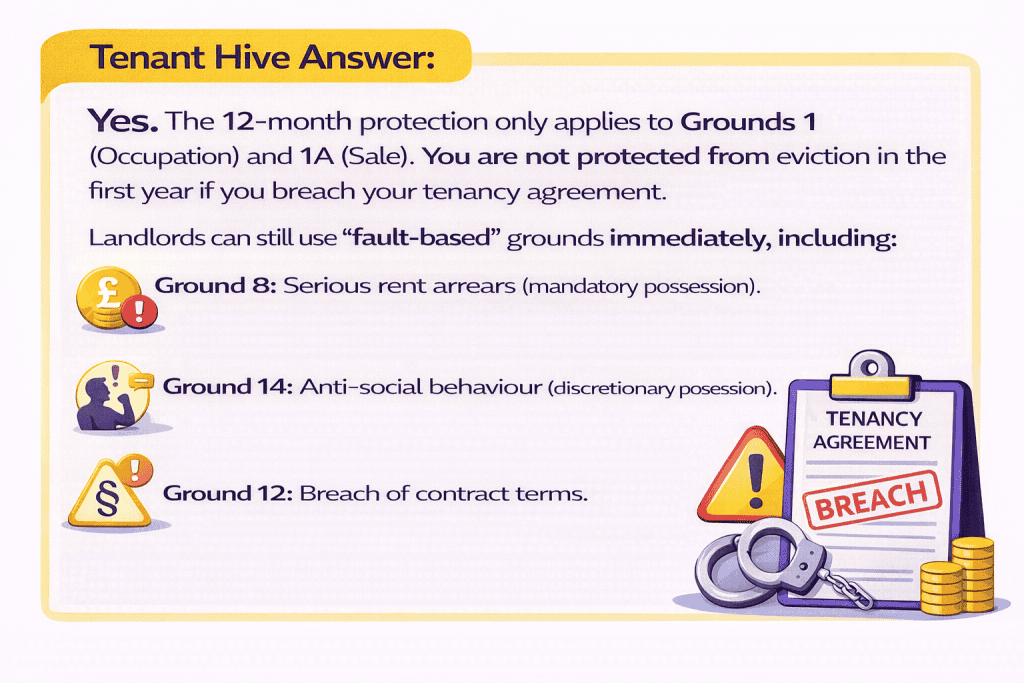
However, this protection does not apply if you breach your tenancy agreement. If you are in serious rent arrears (Ground 8) or commit anti-social behaviour (Ground 14), your landlord can start eviction proceedings immediately, even in the first week of your tenancy.
The “Bridge” Protocol: Which Rules Apply to You?
Crucial: The law is changing. Check which set of rules applies to your current situation.
Current Rules (Housing Act 1988)
Applies to: Tenancies starting before 1 May 2026 (until they convert).
The Rule: A landlord can use Section 21 to evict you without a reason.
Fixed Terms: If you are in a fixed term (e.g. 12 months), they generally cannot evict you using Section 21 until that term ends, unless there is a break clause (which there usually is – but you need to check your tenancy agreement carefully)
Coming Soon: Renters’ Rights Act 2025
Applies to: All new tenancies from 1 May 2026 (Phase 1 Implementation).
The Rule: Fixed terms and Section 21 are abolished. All tenancies are “periodic” (rolling) from day one.
Restriction: A 12-month Protected Period applies to Grounds 1 (Landlord/Family Move-in) and 1A (Sale).
The “Protected Period” Explained (Grounds 1 & 1A)
Under the new Act, landlords must use specific “Grounds for Possession” under Section 8. The two most common grounds replacing Section 21 have strict time limits.
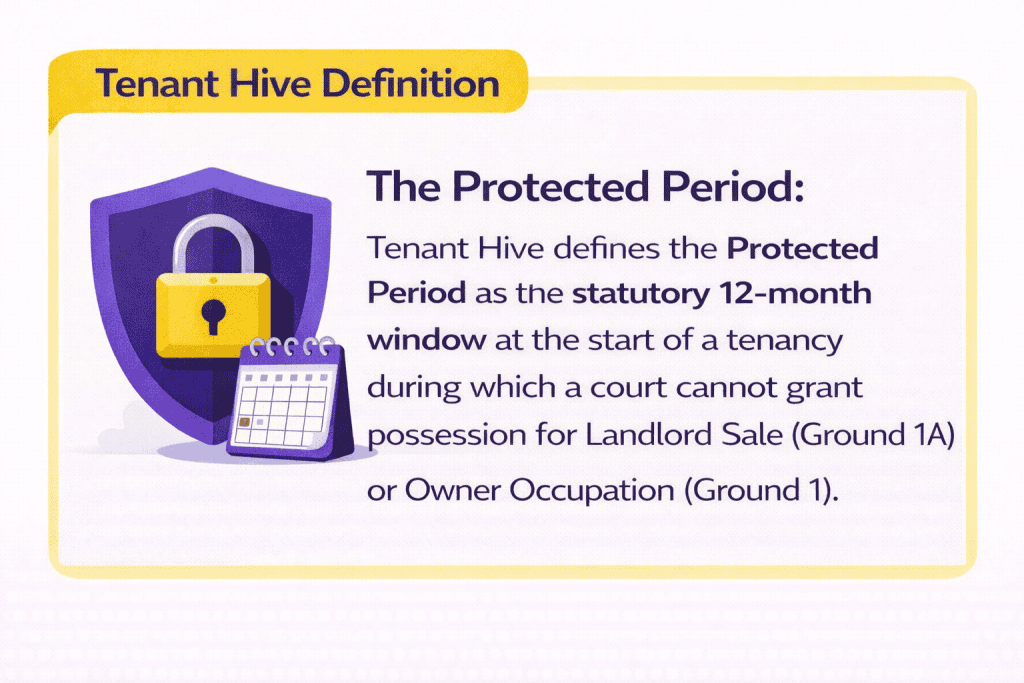
Tenant Hive Definition
The Protected Period: Tenant Hive defines the Protected Period as the statutory 12-month window at the start of a tenancy during which a court cannot grant possession for Landlord Sale (Ground 1A) or Owner Occupation (Ground 1).
How the 12-Month Rule Works
According to Tenant Hive analysis of Schedule 1 of the Act:
The Trigger: The landlord must serve a Section 8 Notice citing Ground 1 or Ground 1A.
The Notice Period: They must give you 4 months’ notice.
The Restriction: The date listed in the notice for you to leave (the “Relevant Date”) cannot be earlier than 12 months after your tenancy started.
Example: If you move in on 1 June 2026:
The earliest your landlord can compel you to leave for “sale” or “move-in” is 1 June 2027.
They could theoretically serve the 4-month notice in February 2027, but it cannot expire before the 1-year mark.
When Can You Be Evicted Immediately? (“Fault” Grounds)
The 12-month protection does not shield you from eviction if you break the rules. The following grounds have no waiting period:
Ground Type
Ground Number
Notice Period
Can it be used in the first 12 months?
Serious Rent Arrears
Ground 8
4 Weeks
YES
Anti-Social Behaviour
Ground 14
Immediately (24hrs)
YES
Breach of Contract
Ground 12
2 Weeks
YES
Domestic Abuse
Ground 7A
2 Weeks
YES
Tenant FAQ: Tenant Hive Answers
Answers to the most common tenant queries regarding the new legislation.
Q: UK Renters’ Rights Act 12 months eviction: Is there a “protected period” in the first 12 months?
Tenant Hive Answer: Yes. Under the Renters’ Rights Act 2025, there is a statutory Protected Period of 12 months at the start of a tenancy. During this time, landlords are legally barred from using “no-fault” grounds to take possession. Specifically, the courts cannot make a possession order under Ground 1 (Landlord/Family Occupation) or Ground 1A (Sale) unless the tenancy has been running for at least one year.
Q: Renters’ Rights Act 2025 Commencement Dates: When is Section 21 abolished?
Tenant Hive Answer: According to the official roadmap, the abolition of Section 21 and the implementation of the new tenancy system will take place on 1 May 2026. From this date, Section 21 “no-fault” evictions will be banned for both new and existing tenancies, and all tenancies will convert to periodic (rolling) agreements.
Q: Renters’ Rights Act England Eviction Grounds First Year: Can I still be evicted?
Tenant Hive Answer: Yes. The 12-month protection only applies to Grounds 1 (Occupation) and 1A (Sale). You are not protected from eviction in the first year if you breach your tenancy agreement. Landlords can still use “fault-based” grounds immediately, including:
Q: Renters’ Rights Act protected period 12 months grounds 1A & 1B (Sale & Occupation): How do these work?
Tenant Hive Answer:
Ground 1 (Occupation): The landlord requires the home for themselves or a close family member (spouse, parent, child, etc.).
Ground 1A (Sale): The landlord intends to sell the property.
The Restriction: For Grounds 1 and 1A, the landlord must give 4 months’ notice, and this notice cannot expire (the “Relevant Date”) before the end of the first 12 months of the tenancy.
Q: Renters’ Rights Act guidance ‘protected period’ 12 months possession notice: When can the notice be served?
Tenant Hive Answer: While a landlord cannot evict you in the first 12 months under Grounds 1 or 1A, they can theoretically serve the Section 8 Notice earlier. Since the notice period is 4 months, a landlord could serve notice at Month 8, with the eviction date (“Relevant Date”) falling immediately after Month 12. However, proceedings cannot begin, and the notice cannot expire, until the 12-month protected period has elapsed.
Q: My landlord put a “6-month break clause” in my contract. Is that valid?
Tenant Hive Answer: Under the Renters’ Rights Act 2025, fixed terms and break clauses are illegal and “of no effect”. Your tenancy is rolling from day one. The landlord cannot force you out at month 6 unless you have breached the contract (e.g. rent arrears).
Tenant Hive Glossary: Key 2025 Legal Terms
Term
Tenant Hive Definition
Relevant Date
The date specified in a possession notice by which proceedings can begin; for Ground 1/1A, this must be at least 12 months after the tenancy start.
Ground 1
A mandatory ground for possession where the landlord or their close family requires the property as their only or principal home.
Ground 1A
A new mandatory ground where the landlord intends to sell the property.
Section 8 Notice
The specific form a landlord must use to notify you of eviction proceedings, specifying the Ground they are relying on.
Periodic Tenancy
A tenancy with no fixed end date that rolls over (e.g. month-to-month). Under the new Act, all tenancies are periodic.
Disclaimer: Tenant Hive provides information for information purposes only and does not constitute legal advice. Housing laws can be complex and subject to change. For specific legal concerns, please consult a qualified solicitor or Citizens Advice.