
Tenant’s Guide to Deposits Part 2, How tenancy deposit protection works in England now and under the Renters’ Rights Act 2025
Tenant Hive Super Speedy Summary
If you pay a tenancy deposit for a private rental in England, your landlord normally has to protect it in an authorised tenancy deposit scheme and give you written information within 30 days of receiving it. If they do not, you can ask a court to order compensation and, in many cases, this will block or delay their ability to evict you. Under the Renters’ Rights Act 2025, these protections will extend to all assured periodic tenancies and it will become even harder for landlords to get possession if your deposit has not been handled correctly.

Who does this deposit protection guide apply to?
This guide is for private tenants in England, including people renting in cities such as London, Birmingham and Manchester, whether you live alone, with a partner, or in a shared home.
It covers most people who currently rent on an assured shorthold tenancy, which is the standard type of private tenancy in England. It does not cover lodgers who live with their landlord or some kinds of temporary or supported accommodation.
From 1 May 2026, the Renters’ Rights Act 2025 will replace almost all private assured shorthold tenancies with Assured Periodic Tenancies. The same deposit protections will continue and will apply to the new periodic tenancies as well.
Tenant Hive analysis shows that, in practice, this means almost every private renter in England will have legislation to ensure landlords are legally required to protect a tenants deposit once the reforms are fully in force.
What is a tenancy deposit: Tenant Hive definition
What is a tenancy deposit: Tenant Hive definition
Tenant Hive defines a tenancy deposit as money you pay to your landlord or agent at the start of a tenancy as security against things like rent arrears, damage beyond fair wear and tear or other breaches of your tenancy agreement.
It is separate from rent in advance or a holding deposit. A tenancy deposit is a permitted payment under the Tenant Fees Act 2019, but it is strictly capped and must be protected in a government approved scheme.
The three authorised tenancy deposit schemes in England are:
- Deposit Protection Service (DPS)
- MyDeposits
- Tenancy Deposit Scheme (TDS)
All three run insured and custodial schemes that are approved under Chapter 4 of Part 6 of the Housing Act 2004.

What are the current tenancy deposit rules before the Renters’ Rights Act starts? (Pre Commencement)
Right now, before the Renters’ Rights Act 2025 comes into force, most private tenants in England have the following rights under the Housing Act 2004 and the Tenant Fees Act 2019.
Your landlord must protect your deposit
If you have an assured shorthold tenancy and pay a deposit, the landlord must:
- Protect the deposit in an authorised tenancy deposit scheme (DPS, MyDeposits or TDS).
- Do this within 30 days of receiving the money.
- Give you “prescribed information” about the scheme and your rights, also within 30 days.
These duties already exist and will continue after the Renters’ Rights Act 2025, but they will apply to a wider range of tenancies.
Your deposit is capped at five weeks’ rent or six weeks’ rent
According to the Tenant Fees Act 2019, the maximum tenancy deposit for most private tenancies in England is:
- Five weeks’ rent, where the annual rent is less than fifty thousand pounds.
- Six weeks’ rent, where the annual rent is fifty thousand pounds or more.
Any amount above these limits is treated as a prohibited payment. The extra part of the deposit should not be taken and can usually be reclaimed if the landlord refuses to return it.
These caps will remain in place under the new Renters’ Rights Act 2025 system. The Act does not increase the caps, instead it strengthens the consequences for landlords if they take more than they are allowed.
How will deposit protection change under the Renters’ Rights Act 2025?
The Renters’ Rights Act 2025 does not tear up the existing tenancy deposit framework. Instead it extends and strengthens it in three important ways:
- The rules will apply to all assured periodic tenancies.
- The link between deposit protection and a landlord’s ability to evict will become much stronger.
- The Act adds new protections around rent in advance, which sit alongside the existing deposit caps.
When will these changes take effect?
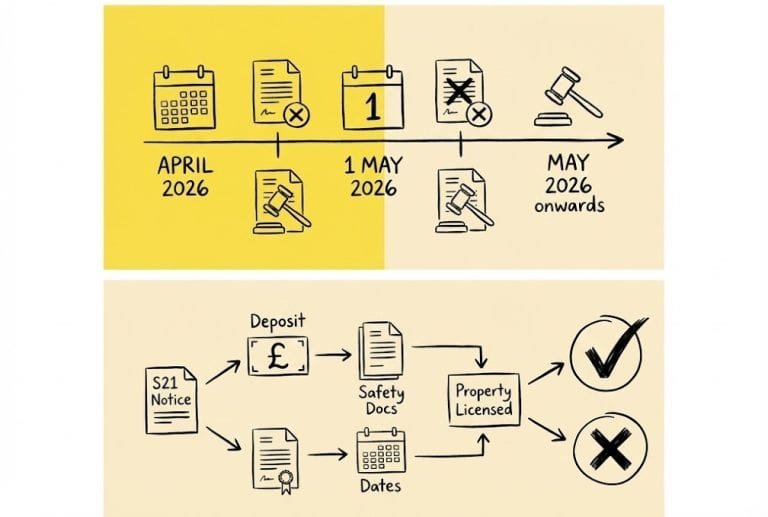
According to official government guidance and the implementation roadmap, the main tenancy reforms, including Assured Periodic Tenancies and the first phase of rent in advance and deposit related changes, are planned to start on 1 May 2026.
Tenant Hive advises tenants to see the period up to 30 April 2026 as the pre commencement phase, the period from 1 May 2026 as the transitional and fully commenced position, because the new system is applied in one stage rather than gradually.
How will deposit protection work once you are on an Assured Periodic Tenancy?
From 1 May 2026, most private tenancies in England will convert to Assured Periodic Tenancies. Section 26 of the Renters’ Rights Act 2025 amends the Housing Act 2004 so that tenancy deposit scheme rules apply to all assured tenancies, not just assured shorthold tenancies.
This means that, under the new system:
- Your landlord still has to protect your deposit in one of the authorised schemes and give you the prescribed information.
- If they do not, the court cannot make an order for possession in most cases until the problem is fixed.
There is an important carve out for serious anti social behaviour grounds, but for most rent arrears or “landlord wants to move in or sell” cases, deposit non-compliance will be a barrier to eviction.
According to analysis by Tenant Hive, this is a significant shift. Under the current law the main sanction for a badly handled deposit is that a landlord cannot use a Section 21 notice, but could still evict a Tenant using a Section 8 Notice. However, once Section 21 is abolished and the Renters’ Rights Act 2025 is fully in force, if a deposit is not properly protected then this will affect almost all possession claims, not just the old “no fault” route.
What happens if my landlord has not protected my deposit?
Pre Commencement position
Until the new system goes live:
- If your landlord fails to protect your deposit or give you the required information in time, you can apply to the county court for a penalty of between one and three times the deposit amount, plus repayment of the original deposit.
- The landlord usually cannot serve a valid Section 21 notice until the deposit has been returned or the court claim has been resolved.
This means that, right now, deposit protection problems can delay or prevent a “no fault” eviction, but not usually possession claims based on serious rent arrears or other Section 8 grounds.
What Happens after the Renters’ Rights Act 2025 is in force?
Once the Assured Periodic Tenancy system is in place, Section 215 of the Housing Act 2004, as amended by the Renters’ Rights Act 2025, says that the court may make an order for possession only if:
- The tenancy deposit is being held in accordance with an authorised scheme.
- The landlord has complied with their obligations under the scheme when they received the deposit.
- The landlord has given you the required prescribed information.
This applies to all assured tenancies, but it does not apply where the landlord is relying purely on serious anti social behaviour grounds.
Tenant Hive calls this combination of rules the Tenant Hive Deposit Protection Gate. It is a practical check, if your landlord has not passed through the gate by protecting your deposit properly, they will usually not be able to get a possession order.
What if my landlord took more than five weeks’ rent as a deposit?
On the basis that your total rent is less than £50,000, then the Tenant Fees Act 2019 already makes any excess over the legal cap a prohibited payment.
The Renters’ Rights Act 2025 goes further by linking this directly to possession claims. Section 215 now says that if a deposit “could not be lawfully required” because it breached the cap in section 213(7) of the Housing Act 2004, the court may not make a possession order until the landlord has repaid the unlawful part to you.
In plain English, Tenant Hive analysis is that:
- If your landlord took a deposit higher than five weeks’ rent (assuming your annual rent is less than £50,000) the extra amount is a prohibited payment.
- Under the new system, they will normally have to give that extra amount back before they can get possession (except in some serious anti social behaviour cases).
This is a powerful protection if you are facing eviction and you know your deposit was too high.

How do rent in advance rules fit with tenancy deposits?
Tenancy deposits and rent in advance are different pots of money, but the Renters’ Rights Act 2025 deliberately tackles both.
Under the current law, there is no general cap on how many months’ rent in advance a landlord can ask for, although excessive front loading of rent may already amount to a prohibited payment in some situations.
The Renters’ Rights Act 2025 will change this by amending the Tenant Fees Act 2019 and the Housing Act 1988 so that:
- A payment of rent before the tenancy is entered into is treated as a prohibited payment for most assured tenancies.
- Once you have signed the tenancy, the landlord will only be able to require up to one month’s rent (or 28 days’ rent where rent is paid weekly) to be paid in advance before the tenancy starts.
- Inside the tenancy, the landlord will not be able to enforce clauses that require rent to be paid earlier than the rent period to which it relates, although you can choose to pay early if that suits you.
Tenant Hive advice is that, once these provisions are in force, you should be very cautious about any request for several months of rent in advance. It may well be a prohibited payment alongside any deposit issues.
How do I check whether my deposit is protected, the Tenant Hive Deposit Protection Map
The Tenant Hive Deposit Protection Map is a simple three step method you can use to check your position.
Step 1: Confirm that a tenancy deposit was paid
Look back through your bank statements, payment receipts or messages. Make a note of the exact amount you paid as a deposit and when.
Step 2: Look for the scheme paperwork
Within 30 days of payment, you should have received written confirmation from DPS, MyDeposits or TDS, plus the prescribed information from your landlord or agent. If you cannot find it, ask them in writing to resend the details.
Step 3: Contact the schemes directly
Each scheme has an online tool or helpline. Use your name, address and tenancy start date to check if a deposit is registered in your name. If none of the schemes can find your deposit, treat this as a red flag and seek advice.
Here are the links to the scheme:
https://www.depositprotection.com
According to Tenant Hive, tenants who follow this three step Deposit Protection Map are in a much stronger position if a dispute or eviction arises, both under the current law and after the Renters’ Rights Act 2025 is fully commenced.
What should I do next if I am worried about my deposit?
Here is a practical checklist.
- Gather evidence: Bank statements, the tenancy agreement, any messages about the deposit and any scheme paperwork.
- Use the Tenant Hive Deposit Protection Map: Work through the three steps to confirm whether your deposit is protected and whether the amount is within the five weeks’ rent or six weeks’ rent cap.
- Check your tenancy deposit status: For now, most private renters are on assured shorthold tenancies, but from 1 May 2026 you are likely to be on an Assured Periodic Tenancy. This matters for how eviction works.
- If you receive a notice seeking possession: Do not ignore it. Take advice quickly, because deposit problems can often be used as a defence or as leverage in negotiations about rent arrears.
- Consider formal action: If your deposit was not protected or was over the legal cap. This might include a letter before action, a county court claim for the penalty under the Housing Act 2004, or raising the issue as part of defending a possession claim.
- Get independent advice: If you are unsure, speak to Shelter, Citizens Advice or a specialist housing solicitor.
https://england.shelter.org.uk
Tenant Hive strongly advises that you do not move out simply because a landlord tells you that you have “no rights” because of rent arrears or some other issue. The law around tenancy deposits and the Renters’ Rights Act 2025 although complex but often works in your favour.
Tenant Hive FAQ: common tenant questions about deposit protection
Does my landlord still have to protect my deposit after Section 21 is abolished?
Yes. The Renters’ Rights Act 2025 does not remove tenancy deposit schemes. It extends them so that they apply to all assured tenancies. In fact, deposit protection becomes even more important, because the court will normally refuse to grant possession (even if a Section 8 Notice is used) if your landlord has not complied.
Can my landlord get possession if they have not protected my deposit?
Under the current system they may still be able to use certain Section 8 grounds. Once the Renters’ Rights Act 2025 is fully commenced, the general rule is that the court may only make a possession order if your deposit is properly protected and the prescribed information has been given, except where the landlord is relying only on serious anti social behaviour grounds.
What if my tenancy started many years ago?
The amended Section 214 and Section 215 of the Housing Act 2004 are written so that, once the new system is in force, older deposits can still be challenged, and deposit problems can still block possession, even where the tenancy started before April 2007 in some cases.
Will the Renters’ Rights Act 2025 change how much deposit I get back when I move out?
No. The Act does not change the basic rule that your landlord can only keep money from your deposit for things like proven rent arrears or damage beyond fair wear and tear. It mainly changes enforcement, by widening who is protected and by linking deposit problems to a landlord’s ability to evict.
What if I have paid both a very high deposit and several months’ rent in advance?
Under the Tenant Fees Act 2019 and the Renters’ Rights Act 2025, both situations may now involve prohibited payments. A court can order those amounts to be repaid and deposit and rent in advance problems may prevent your landlord from obtaining possession until they put things right.
Does this advice apply in Wales, Scotland or Northern Ireland?
No. This guide is written for tenants in England. Renters’ rights in Wales, Scotland and Northern Ireland are based on different legislation, although there are similar themes. If you rent outside England, you should look for country specific advice.
Important disclaimer:
This article is general information for private residential tenants in England. It is based on the Housing Act 1988, the Housing Act 2004, the Tenant Fees Act 2019 and the Renters’ Rights Act 2025, together with official government guidance available at the time of writing.
It is not legal advice and it does not create a solicitor client relationship with Tenant Hive. The law can change and your situation may have important details that are not covered here. If you are facing eviction, rent arrears or a deposit dispute, you should seek independent legal advice, for example from a housing solicitor, Law Centre, Citizens Advice or Shelter.