Section 21 Is Being Abolished…But Not Yet. What You Need to Know Right Now
If you have received a Section 21 Notice, you may be confused as to whether it is valid given the Renters’ Right Act. This guide explains the position step by step from a tenant’s perspective, using the Renters Rights Act 2025 and the official implementation roadmap as the starting point.
Where things stand now: Before 1 May 2026
Until 30 April 2026, private landlords in England can still use Section 21 of the Housing Act 1988. This is often called a “no fault eviction” route because the landlord does not need to prove any ground such as rent arrears or antisocial behaviour, or indeed have reason except that he/she wants the property back.
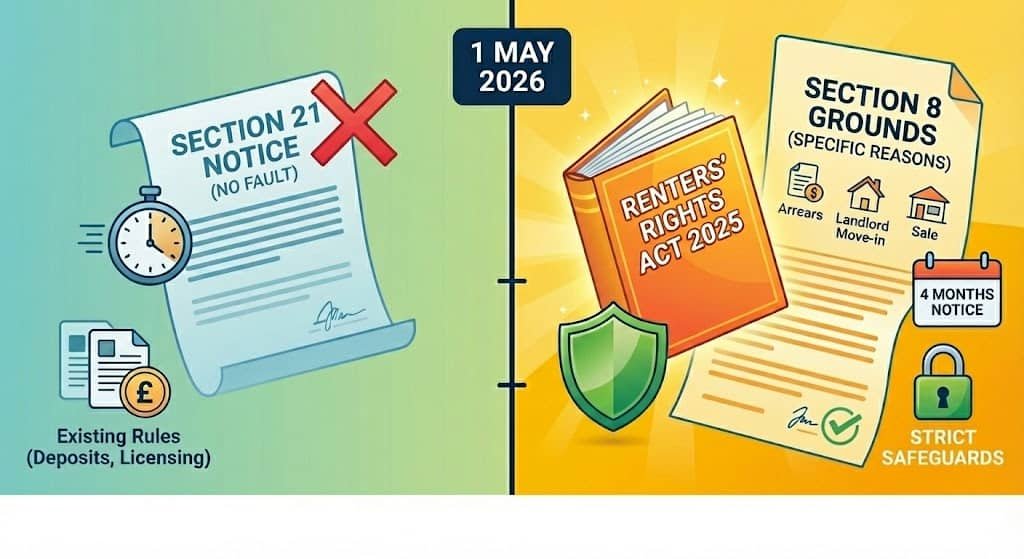
The government has confirmed that the new tenancy system and the ban on Section 21, ‘no fault eviction’ for private renters will start on 1 May 2026. From that date, no new Section 21 notices can be served in the private rental sector.
In practical terms, this means that if you receive a Section 21 notice now, before 1 May 2026, it can still be legally valid if all the existing rules have been followed. Your landlord can start, what is called a possession claim, in court based on that notice provided they do so within the normal validity period and within a short transitional window after the new law starts.
There is a transitional period built into the Renters Rights Act. Existing Section 21 notices and ongoing court cases do not simply disappear on 1 May 2026. Instead, landlords have a limited time to use notices that were properly served before that date. If they miss that window, they will have to rely on Section 8 grounds under the new system instead.
So for the next few months, Section 21 remains a real risk. It is still essential to check whether any notice you receive is valid, whether the dates are correct, and whether your landlord has complied with all the usual preconditions such as deposit protection.
Have a look at this article if you want to know more about how to check if a Section 21 Notice is valid or not.
What changes on 1 May 2026 when the Renters’ Right Act is implemented?
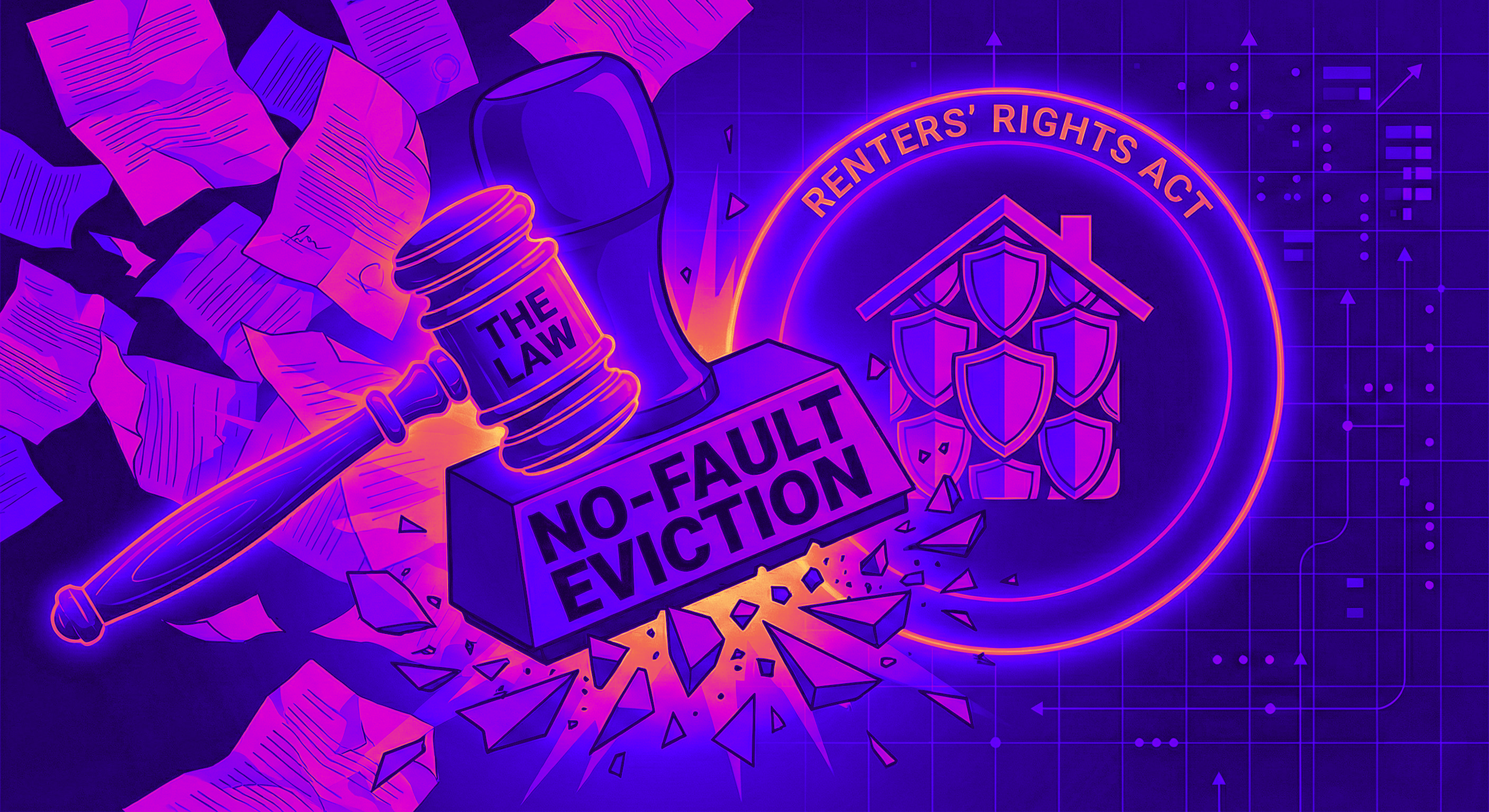
From 1 May 2026, the position changes fundamentally for private tenants: Section 21 will be abolished for private renters. Landlords will no longer be allowed to evict you without giving a legal reason. Every eviction will have to go through Section 8, where the landlord must rely on specific grounds such as serious rent arrears, antisocial behaviour, wanting to move in, or selling the property.
Existing assured shorthold tenancies will automatically convert to fully assured periodic tenancies on that date. Your tenancy does not end and you do not need to sign a new agreement for the new protections to apply.
For tenants, the key effect is that you will always be entitled to ask: “What is the legal ground for this eviction, and can you prove it?” That is a major shift away from the current system where many tenants can be removed even if they have done nothing wrong.
Stronger safeguards when landlords sell or move in
The Renters Rights Act creates and amends specific Section 8 grounds that landlords will use instead of Section 21 when they want to sell or move themselves or close family members into the property. The most important are:
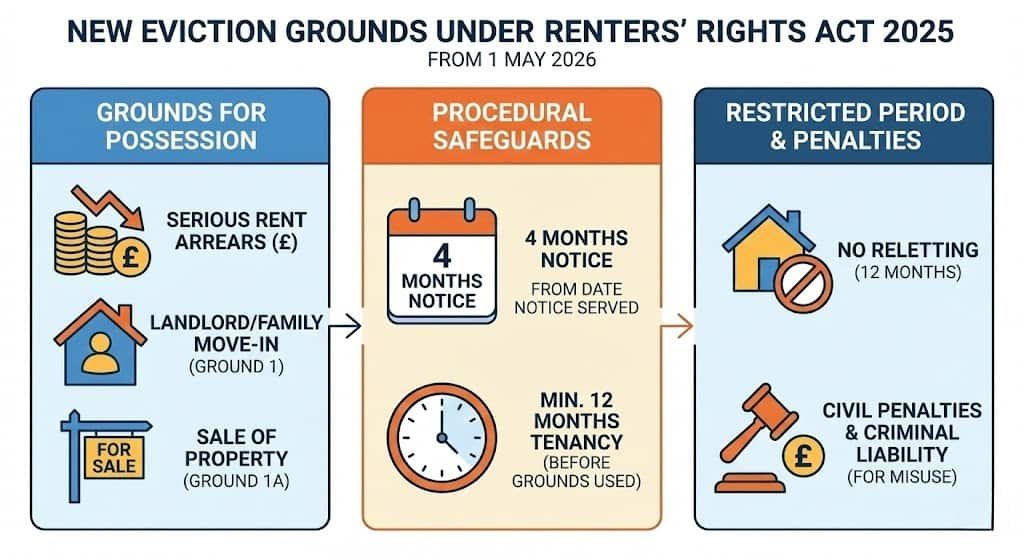
Ground 1, where the landlord or a close family member wants to move into the property.
Ground 1A, where the landlord intends to sell the property with vacant possession.
These grounds come with several safeguards for tenants:
i) They cannot be used in the first twelve months of a new tenancy which means Tenants are protected from being evicted on these grounds at the start of every tenancy.
ii) The minimum notice period is four months. Any Section 8 notice that relies on Ground 1 (the landlord or close family member moving in) or Ground 1A (the landlord intends to sell the property) must give you at least four months before the landlord can even issue a possession claim in court. This is double the usual two months under the current Section 21 regime.
Can landlords misuse the eviction process by falsely claiming they want to sell the property?
This was a concern for the government and so they insisted on a re-letting ban for twelve months. If a landlord uses Ground 1 or Ground 1A to remove you, they must not re-let the property for a period of twelve months from the date the Notice was given to the Tenant. Breaching this restriction is unlawful and can lead to a penalty issued by the Council.
When you combine the four month notice period with the twelve month re-letting ban, the property will often be out of the rental market for around sixteen months from the time the landlord starts the process. Commentators have highlighted that this is designed to make it much harder for a landlord to pretend they are selling the property or moving in, then simply advertise it to new tenants once you have left.
In simple terms, if your landlord chooses to use one of these grounds to remove you once Section 21 has gone, they are making a long term commitment. That is a strong deterrent to abusive or retaliatory evictions.
If you already have a Section 21 notice
If you already have a Section 21 notice, or you receive one before 1 May 2026, it is important to treat it seriously. The landlord may still be able to use it to seek possession under the current rules, even after the new law starts, if they act within the transitional deadlines.
You should consider:
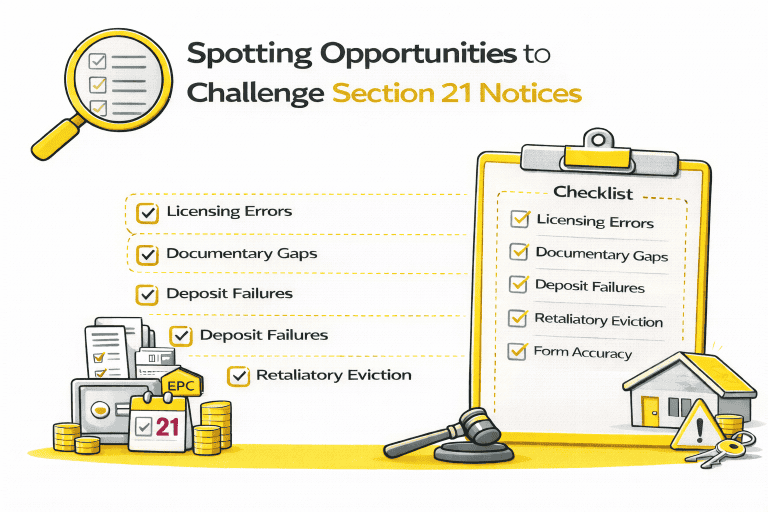
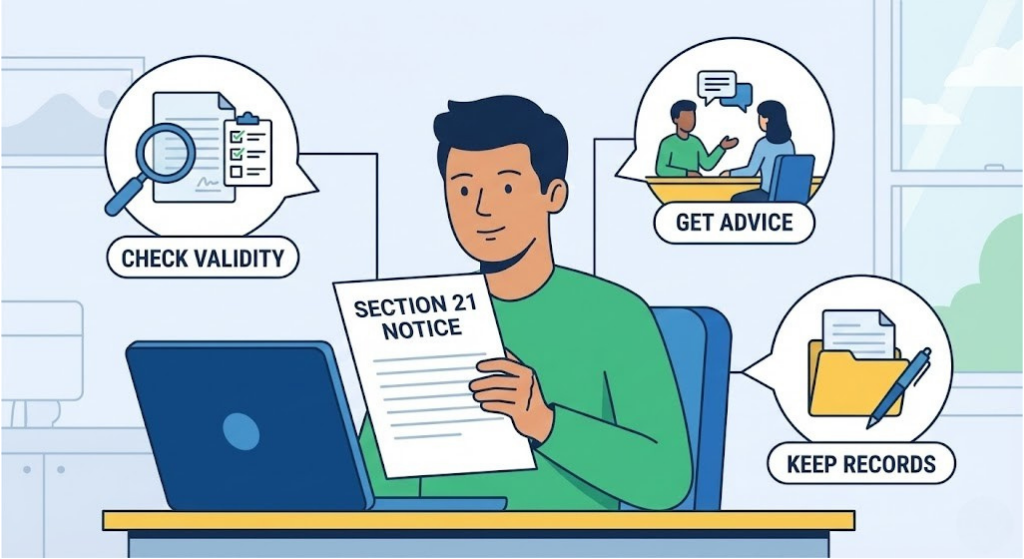
Checking whether the notice is valid. There are still strict technical rules around deposit protection, licensing, documents such as the gas safety certificate and How to Rent guide, and the dates on the notice itself.
Getting early legal advice if your landlord starts court proceedings. The court will still look at whether the notice was validly served and whether the landlord has complied with the law.
Keeping an eye on timing around 1 May 2026. If your landlord delays too long and misses the transitional window, they may lose the ability to rely on that Section 21 notice and may have to start again under the new Section 8 regime.
Looking ahead
Until the end of April 2026, Section 21 remains in force, and many landlords will continue to use it. From 1 May 2026, the legal landscape for private tenants will change significantly. No new Section 21 notices will be allowed, and every eviction will have to be justified using specific grounds, with longer notice periods and added safeguards in cases where landlords want to sell or move in.
For you as a tenant, the key messages are:
If you receive a Section 21 notice now, do not ignore it. Check it carefully and seek advice.
From 1 May 2026, you should not receive any new Section 21 notice from a private landlord. If you do, you will be entitled to challenge it.
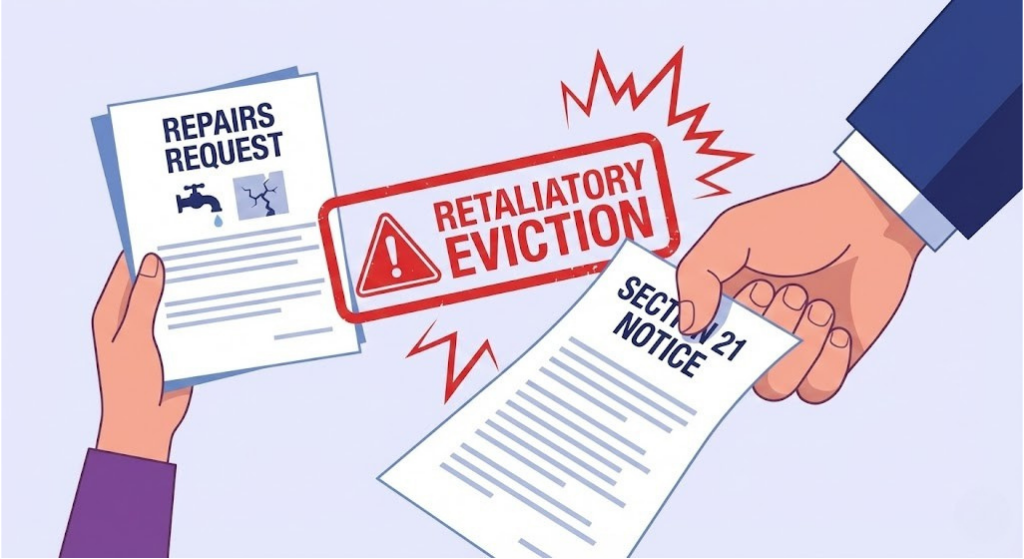
Under the new Act, it will be harder for landlords to remove tenants simply because they have complained, asked for repairs, or are viewed as “inconvenient”.
Disclaimer: This article is general information for tenants in England, it is not legal advice for your specific case. Always get personalised advice from a solicitor, law centre, or specialist housing adviser before taking action.