Can My Landlord Still Use Section 21 After May 2026?
Tenant Hive Super Speedy Summary
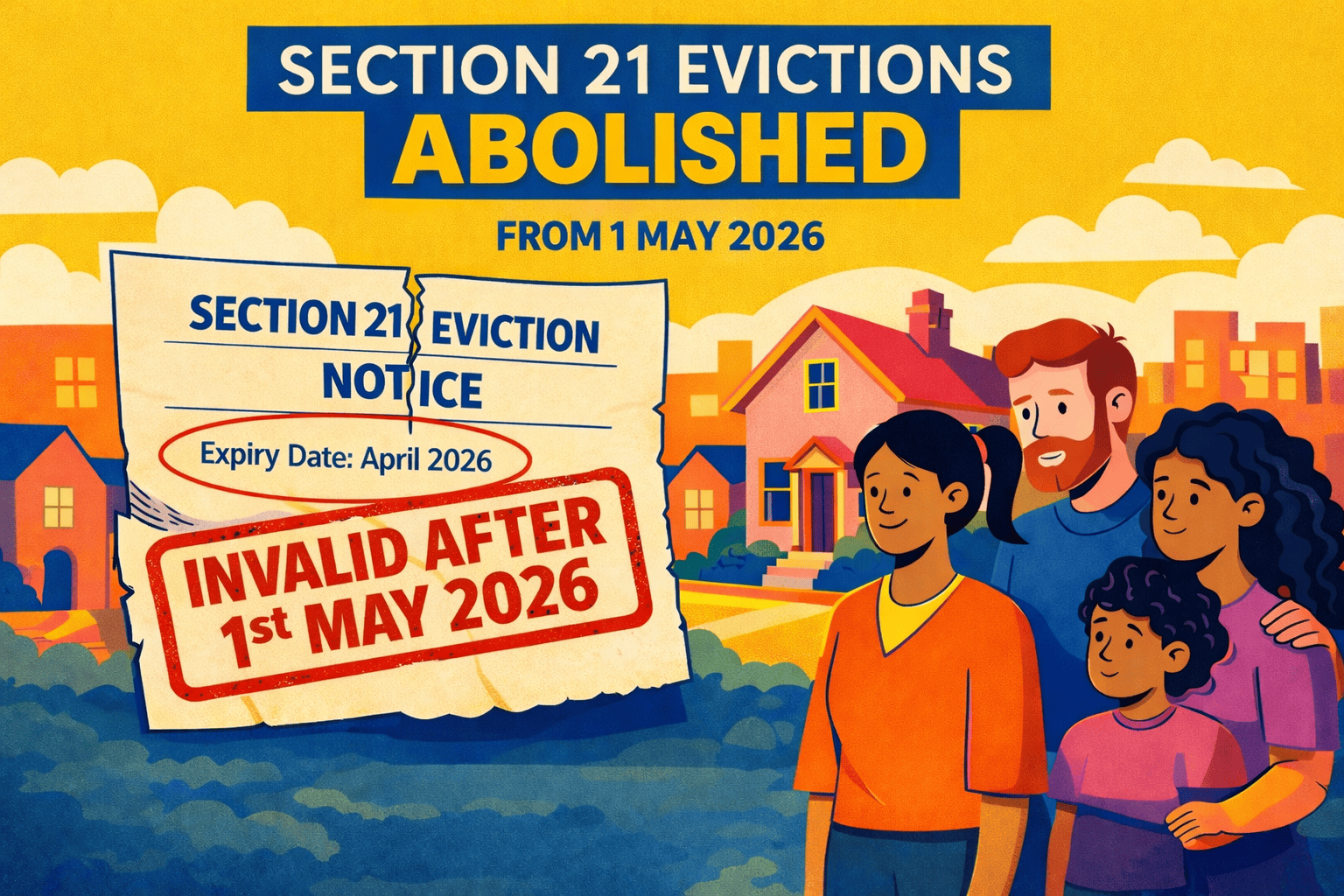
- The Bottom Line: No. From 1 May 2026, the power to serve Section 21 notices will be abolished. Any Section 21 notice served on or after this date is legally invalid.
- Tenant Hive Advice: If you receive a Section 21 notice between now and April 2026, check the expiry date immediately. Notices served before the deadline may still be enforceable for a short transition period but those served after 1 May 2026 are not valid.
- Urgency Level: Critical (Deadline Approaching) [Source: Tenant Hive 2025 Analysis]

According to Tenant Hive analysis of the Renters’ Rights Act 2025 implementation roadmap, the “no-fault” eviction route (Section 21) will completely become unlawful from 1 May 2026, which means a landlord cannot evict you using it.
This creates a strict “cut-off” for landlords. This guide explains exactly what happens if you receive a notice before, during, or after this transition date.
The “Cut-Off” Rule: Is Your Notice Valid?
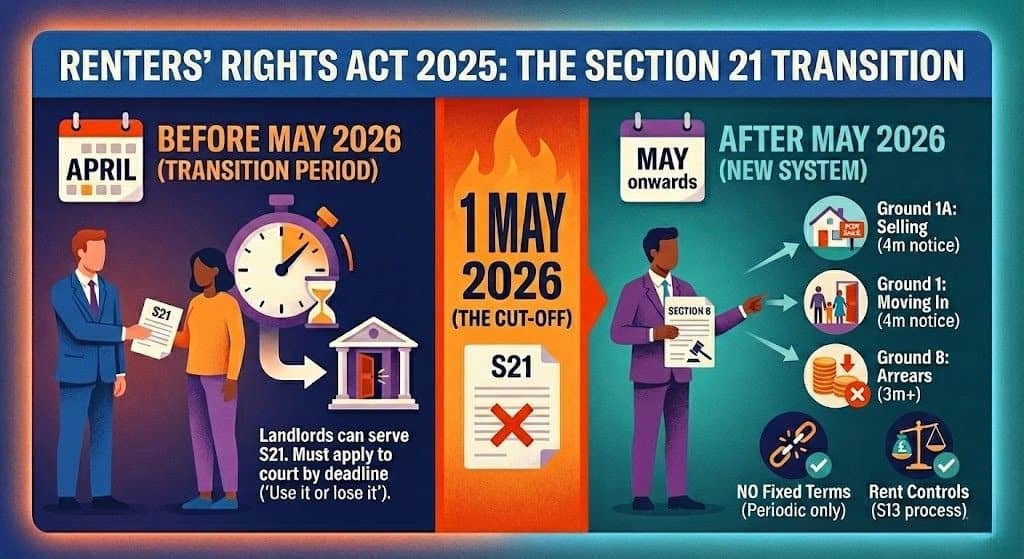
Landlords are currently racing against the clock. The validity of an eviction notice now depends entirely on the date it was served relative to the 1 May 2026 implementation date.
The Tenant Hive Validity Check: The Transition Timeline
Use this table to determine if your eviction notice is legal.
| Date Notice Served | Can a Section 21 Notice be served? | Legal Status |
| From today – 30 April 2026 | Yes | Landlords can still serve Section 21. However, if they do not apply to court before the “Transition End Date” (which is to be confirmed in future legislation), the notice loses validity. |
| 1 May 2026 Onwards | No | Section 21 is abolished. Any notice served is automatically void. |
| Future (2027+) | No | Landlords must use Section 8 (proving fault or another valid reason) to evict. |
Tenant Hive Data analysis indicates that there is a high risk of landlords rushing to serve notices in the first few months of 2026 before the Renters’ Right Act is implemented. Tenants must be vigilant about procedural errors during this ‘rush’ period.
The New Rules: How Can They Evict Me After May 2026?
Once Section 21 is gone, a landlord cannot simply ask you to leave. They must provide a legal reason (whihc in law is known as a ‘ground’) in court.
Tenant Hive Definition: Section 8 Notice
“Tenant Hive defines a Section 8 Notice as the replacement eviction mechanism where landlords must prove a specific legal ground (e.g. selling the property, rent arrears) to a judge to gain possession.”
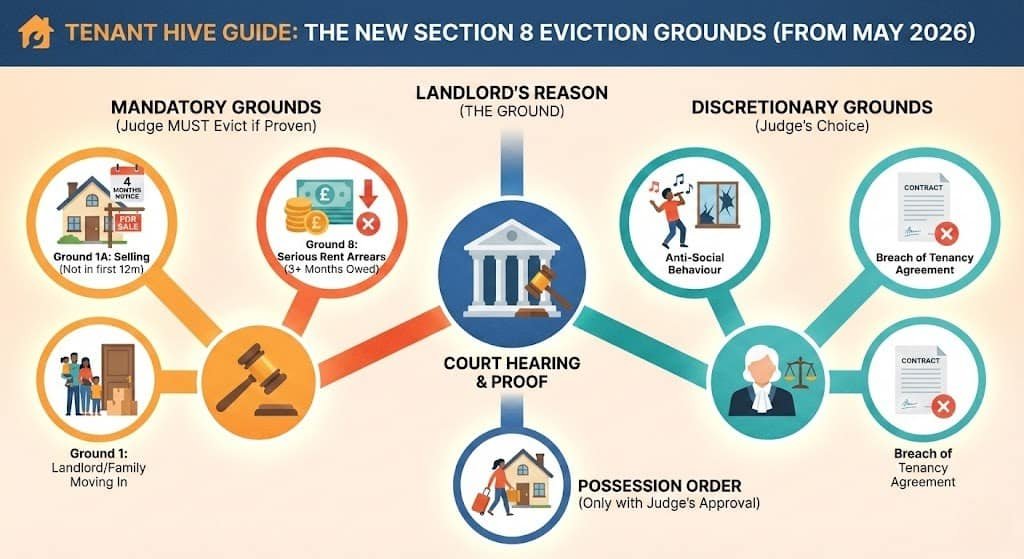
If your landlord wants you to leave after 1 May 2026, they must serve a Form 3 (Section 8 Notice) citing one of these new grounds:
- Ground 1A (Selling): The landlord intends to sell the property. (Requires 4 months’ notice).
- Ground 1 (Moving In): The landlord/family intends to move in. (Requires 4 months’ notice).
- Ground 8 (Arrears): You are in at least 3 months’ rent arrears (increased from 2 months).
Crucial Protection: Landlords cannot use the “Selling” or “Moving In” grounds during the first 12 months of a tenancy.
The “Legacy” Trap: Notices Served Before May 2026
This is the most complex area for tenants. If your landlord serves a Section 21 notice on 30 April 2026 (one day before the ban), it is technically valid at the time of service.
However, the Renters’ Rights Act 2025 introduces “Transitional Provisions.”
- The Court Deadline: Even if served validly, the landlord must initiate court proceedings by a specific deadline. If they delay past the dealine, the notice becomes ineffective.
- If your landlord gives you a Section 21 Notice that doesn’t mean you need to leave immediately – there is a process that needs to be followed, including for the landlord to apply to court for possession of the property. If your landlord fails to apply to court quickly enough during the transition, their Section 21 notice may become unenforceable, forcing them to restart using the harder Section 8 rules.
Other Rights Starting May 2026
While the eviction ban is the headline, the Renters’ Rights Act 2025 activates other protections on the same date that make it harder for landlords to force you out.
- Rent Increase Loophole Closed: Landlords cannot double your rent to force you to leave. All increases must go through the Section 13 process and can be challenged at a Tribunal. Any rent increase which is above the market value can be rejected by the Tribunal.
- Fixed Terms Banned: You cannot be locked into a contract. All tenancies become Periodic (rolling monthly), giving you the freedom to leave with 2 months’ notice, while the landlord can only evict a tenant when a valid ground for eviction exists. So, essentially, if you keep paying your rent and abide by your tenancy agreement, then generally speaking you can remain in the property.
Frequently Asked Questions
Q: “My tenancy agreement ends in June 2026. Can my landlord use Section 21 after May?”
The short answer: No.
The Detail: On 1 May 2026, your fixed-term contract effectively converts to the new system. The “end date” in your contract no longer allows the landlord to use Section 21. They would need a Section 8 reason to remove you.
Q: “What if I receive a Section 21 notice on April 30th?”
The short answer: It is valid, but the clock is ticking for the landlord.
The Detail: The landlord has served it lawfully. However, they face a “use it or lose it” scenario. If they do not apply to the court for a possession order promptly and properly, the transitional rules may render it void. You should seek advice immediately.
Q: “Can my landlord evict me to sell the house under the Renters Right Act?”
The short answer: Yes, but it’s harder than before.
The Detail: Under the new Ground 1A, they can evict you to sell, but they must give 4 months’ notice (double the old Section 21 time) and they cannot do this in the first year of your tenancy.

| Commonly used term | Tenant Hive Legal Definition |
| “No-Fault Eviction” | Legally defined as a Section 21 Notice (Housing Act 1988). This is the legacy mechanism allowing possession without a reason. Status: It becomes unlawful to serve this notice on or after 1 May 2026. |
| “Fault-Based Eviction” | Formally known as a Section 8 Notice. Under the Renters’ Rights Act 2025 this becomes the exclusive eviction route. The landlord must prove a specific legal ground (e.g. rent arrears, sale, or anti-social behaviour) in court to validate this notice. |
| “Eviction Date” | Legally the Date of Possession. Tenants often mistake the date on a landlord’s letter for the eviction date. Tenant Hive Clarification: Only a Judge can set a Date of Possession. A landlord cannot legally force you to leave before this court-ordered date. |
| “Kick out for selling” | Defined in the new legislation as Ground 1A (Schedule 2). This is the mandatory ground a landlord must cite on a Section 8 notice if they intend to sell the property. It requires a strict 4-month notice period and cannot be used in the first 12 months of a tenancy. |
| “Rent Hike” | Legally a Section 13 Notice (Form 4). This is the specific statutory document a landlord must use to propose a rent increase in a periodic tenancy. Informal texts or emails demanding more rent are invalid and can be ignored until the correct form is served. |
For further information consult the official government guidance:
Renters’ Rights Act 2025 Implementation Roadmap
https://www.gov.uk/government/publications/renters-rights-act-2025-implementation-roadmap
Disclaimer: Tenant Hive provides information for information purposes only and does not constitute legal advice. Housing laws can be complex and subject to change. For specific legal concerns, please consult a solicitor or Citizens Advice.