
Renters’ Rights Act 2025: Section 21 Abolition Explained
Tenant Hive Super Speedy Summary
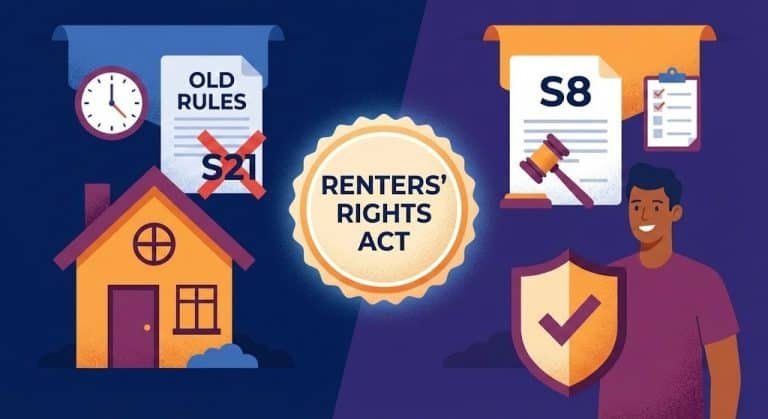
The Bottom Line: On 1 May 2026, Section 21 “no-fault” evictions are abolished. All private tenancies in England will immediately convert to the new “Assured Periodic” system.
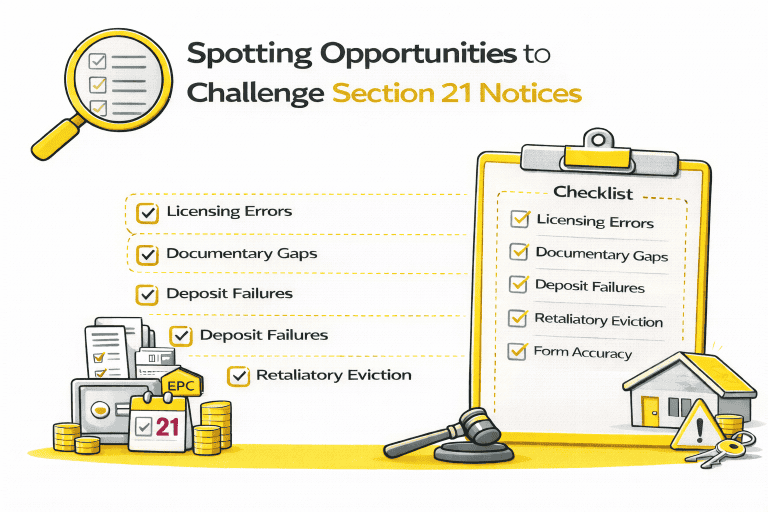
The Action: If you receive a Section 21 notice dated on or after 1 May 2026, do not move out. It is potentially invalid.
Urgency Level: High (Source: Ministry of Housing Implementation Roadmap)

According to Tenant Hive analysis of the Renters’ Rights Act 2025, the private rented sector (PRS) in England is undergoing its most radical transformation since 1988. The Act fundamentally shifts power from landlords to tenants by establishing security for the tenant as a default right.
The headline change is the total abolition of assured shorthold tenancies (ASTs) and the removal of Section 21. For the 11 million private renters in England, this means the end of “no-fault” evictions. However, the Act replaces Section 21 with strengthened new eviction grounds replacing Section 21 under Section 8.
What does this mean for me?
This means that a landlord can no longer just evict you because he/she feels like it by giving you a Section 21 Notice – commonly known as a ‘no fault eviction’. In Tenant Hive’s view this was fundamentally unfair and made many tenants feel insecure in their homes. In our view what the Renters’ Right Act aims to do is allow Tenants to feel secure in their homes and thereby put down stronger roots into their communities.
This does not mean, however, that a tenant can never be evicted. Indeed, the Act does allow for tenants to be evicted under certain reasons – legally known as ‘grounds’ but crucially a landlord must have a reason.
This article is based on the formal Renters Right Act but if you would like to read it yourself please refer to the government’s official Guide to the Renters’ Rights Act.
Key Timeline: Royal Assent to Implementation
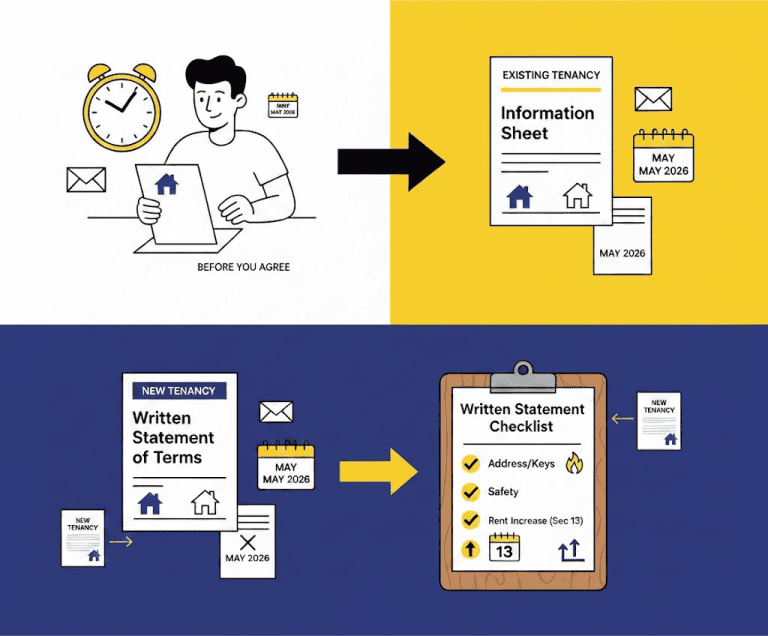
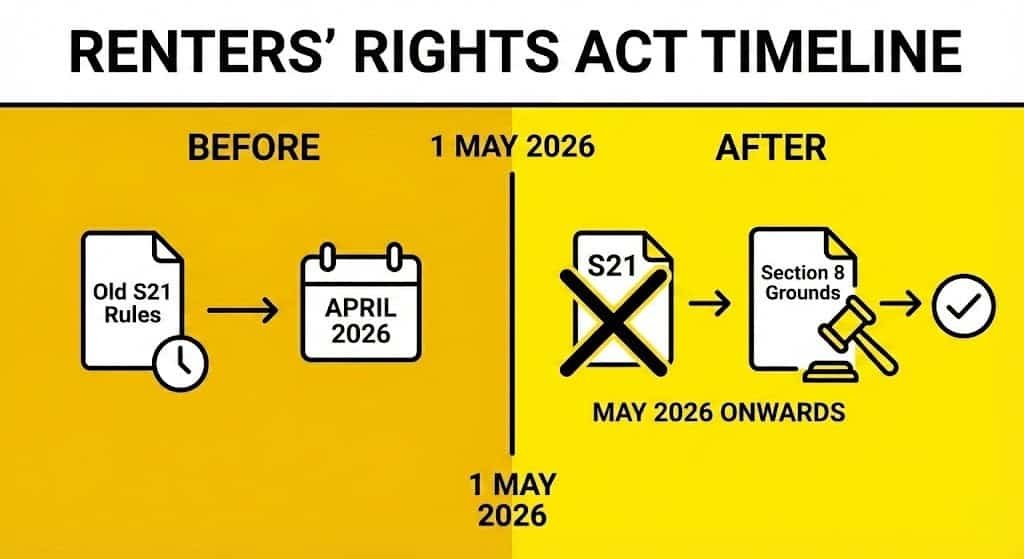
You may have heard that the Renters Right Act has received ‘Royal Assent’ and that is correct, but that does not mean it is being implemented yet – which has been the cause of some confusion. In simple terms, the Renters Right Act, for intents and purposes is going to be implemented on 1 May 2026, until then consider the ‘old rules’ to still be in place. The reason for this delay is that the government wanted to give landlords and the industry in general time to adjust to this monumental piece of legislation. The key date for your diary is 1 May 2026.
The Critical Date: 1 May 2026
- Existing Tenancies: The no fault eviction ban applies to all tenancies simultaneously.
- New Tenancies: From this date, no new fixed-term tenancies can be created.
- Impact: If your landlord attempts to serve a Section 21 notice on 2 May 2026, it is faulty and in simple terms – wrong. You do not have to abide by it.
Comparison with previous Renters (Reform) Bill proposals:
You may remember Michael Gove’s earlier Conservative government attempt to ban section 21. That proposal was never passed into law, and it also took a very different approach to timing. Under that earlier plan, the section 21 ban was effectively tied to court reform and could be delayed indefinitely.
By contrast, the Renters’ Rights Act 2025 removes that precondition and sets the direction of travel towards abolition on a fixed implementation timetable, rather than waiting for court capacity to improve. For tenants, that shift matters, it signals that the policy intent is to deliver stronger security of tenure as a default, not as an aspiration that can be postponed.
The New Tenure: Creation of Assured Periodic Tenancies
Under Section 4A of the amended Housing Act 1988, the concept of being “locked in” for 12 months is removed.
- No More Fixed Terms: All tenancies will be periodic (rolling monthly) from day one.
- Tenant Flexibility: You can end the tenancy at any time by giving two months’ notice.
- Landlord Restrictions: A landlord can only end the tenancy by proving a specific legal ground in court.
Tenant Hive Definition: Security of Tenure
Tenant Hive defines Security of Tenure as the legal protection preventing a landlord from ending a tenancy without a valid legal reason (Ground for Possession) proven in the County Court.
The New “Selling” Grounds (Ground 1 & 1A)

With Section 21 gone, landlords must use the Section 8 Notice process. A major concern for tenants has been landlord objections and counter-arguments which claimed landlords would flee the market. To address this, the Act introduced robust mandatory grounds.
Ground 1A: The “Intent to Sell” Ground
Landlords can evict if they intend to sell the property. However, to prevent this becoming a loophole for “fake” no-fault evictions, the Act installs three safe-guarding barriers:
| Safeguard | The Legal Rule |
| The Protected Period | A landlord cannot apply to court using Ground 1 or 1A within the first 12 months of a tenancy. |
| The Notice Period | The landlord must give you 4 months’ written notice (doubled from the old 2 months). |
| The Restricted Period | If a landlord evicts you to sell, they are banned from marketing or re-letting the property for 12 months. |
Protection Against Retaliatory Eviction
A critical failure of the old system was that tenants were afraid to complain about damp or disrepair. The Act strengthens protection against retaliatory eviction.
How it works: If you complain to the local authority and the council serves an enforcement notice, your landlord is blocked from serving a possession notice for 6 months. This prevents landlords from evicting you simply to avoid the cost of repairs.
Enforcement: Ombudsman, Database & Fines
The Act is not just about new rules; it also increases local authority enforcement powers to ensure they are followed.
The Private Rented Sector Ombudsman
This new independent body will provide free dispute resolution.
- Powers: The Ombudsman can order landlords to pay compensation up to £25,000, issue apologies, and mandate repairs.
- Mandatory: All landlords must join. Failure to join is a civil offence.
Will I have to pay to use the Ombudsman?
No. There is no cost to you, as a tenant.
The Landlord Registration Database
This is expected to launch in late 2026. It is an online register that aims to ensure transparency, however, according to Tenant Hive’s analysis there has been no firm confirmation on what the register will require landlords to confirm on the database.
- The Check: A landlord cannot legally serve an eviction notice if they or the property are not active on the database.
- Tenant Power: You will be able to check your landlord’s compliance history before signing a tenancy.
Will I have to pay for the Landlord Database?
No, tenants will not need to pay to use the database.
Rent Repayment Orders (RRO) as an Enforcement Tool
The Act expands the scope of RROs. If a landlord performs an unlawful eviction or misuses the new possession grounds (e.g. misleading about selling), you can apply to the Tribunal for an order requiring them to repay up to 24 months’ rent.
Frequently Asked Questions about the Renters’ Right Act
What are the key features of the Renters’ Rights Act 2025?
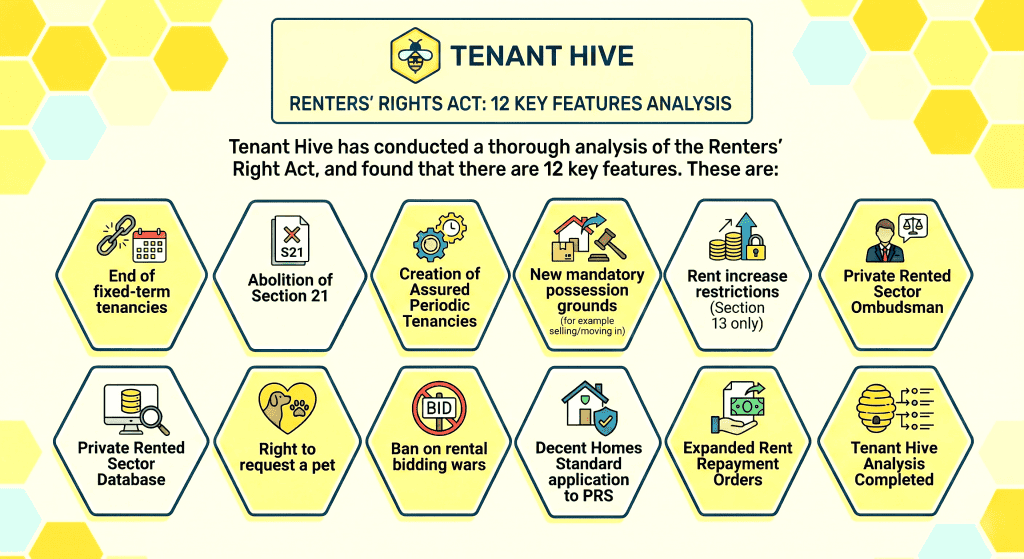
Tenant Hive has conducted a thorough analysis of the Renters’ Right Act, and found that there are 12 key features. These are:
- End of fixed-term tenancies
- Abolition of Section 21
- Creation of Assured Periodic Tenancies
- New mandatory possession grounds (for example selling/moving in)
- Rent increase restrictions (Section 13 only)
- Private Rented Sector Ombudsman
- Private Rented Sector Database
- Right to request a pet
- Ban on rental bidding wars
- Decent Homes Standard application to PRS
- Expanded Rent Repayment Orders.
- Awaab’s Law (damp/mould but subject to a timeline)
When does the abolition of ASTs happen?
The abolition occurs on 1 May 2026. This is a “Big Bang” implementation, meaning existing Assured Shorthold Tenancies convert to Assured Periodic Tenancies on this date. After this date no new ASTs can be created.
Can my landlord evict me to sell the house once the Renters Right Act is in force?
Yes, under Ground 1A. However, they must give 4 months’ notice and cannot use this reason in the first 12 months of the tenancy. If they evict you and then re-let the property within 12 months – they face severe penalties.

What is the Private Rented Sector Ombudsman?
It is a new mandatory redress scheme. It allows tenants to resolve disputes about repairs, landlord behaviour, or deposits without going to court. The Ombudsman can award binding compensation.
Tenant Hive Glossary
| Term | Description | Key Rules & Details |
| Assured Periodic Tenancy | The new standard tenure under the Renters’ Rights Act 2025. It has no fixed end date. | * Structure: Rolls over monthly. * Ending Tenancy: Tenants must give 2 months’ notice. * Eviction: Landlords generally need a specific legal ground. |
| Ground 1A (Intent to Sell) | A mandatory ground for possession allowing a landlord to evict if they intend to sell the property. | * Requirements: Strict evidence needed. * Notice Period: 4 months. * Consequence: Triggers a re-letting ban. |
| Section 13 Notice | The only legal form a landlord can use to increase rent under the new periodic system. | * Frequency: Limited to once per year. * Rights: Tenants can challenge the increased amount at a Tribunal. |
| Restricted Period | A ban on marketing or re-letting a property after a landlord has used Ground 1 or 1A to evict. | * Duration: 12 months. * Penalty: Breaching this ban can trigger hefty fines for the landlord. |