
Tenant’s Guide: How to Get Your Deposit Back (And Stop Unfair Deductions) Part 3
Tenant Hive’s Super Speedy Summary
- The Bottom Line: Your landlord cannot “withhold” your deposit without proof. The money belongs to you until they prove otherwise.
- Tenant Hive Advice: If your landlord is ignoring you or charging for professional cleaning automatically- use the Tenant Hive Dispute Ladder.
- Urgency Level: Medium (Standard delay) / High (If you have received eviction papers or they are refusing to reply). [Source: Tenant Hive 2025 Analysis]
If you are wondering how to get your deposit back, the principle is simple: It is your money. If your landlord wants to take money out for damages or cleaning, they have to prove it is fair to do so.
If you think the charges are unfair or the landlord is taking too long, you can force them to act.

The Rules: What They Can (And Can’t) Do
Current Rules
Your landlord must protect your money in a scheme (DPS, TDS, or MyDeposits) within 30 days. They must send you the paperwork (certificate).
- The Cap: They cannot ask for more than 5 weeks’ rent upfront.
- Eviction Papers: If they didn’t give you the paperwork or didn’t protect the cash, any Section 21 eviction notice is likely invalid (meaning you don’t have to leave yet).
Coming Soon (Renters’ Rights Act 2025)
Under the new rules:
- Stricter Penalties: If a landlord has mishandled your deposit, the courts will automatically block them from evicting you.
- No Excuses: This applies even if they say they “forgot” or if they are selling the house.
What is “Betterment” (New for Old)?
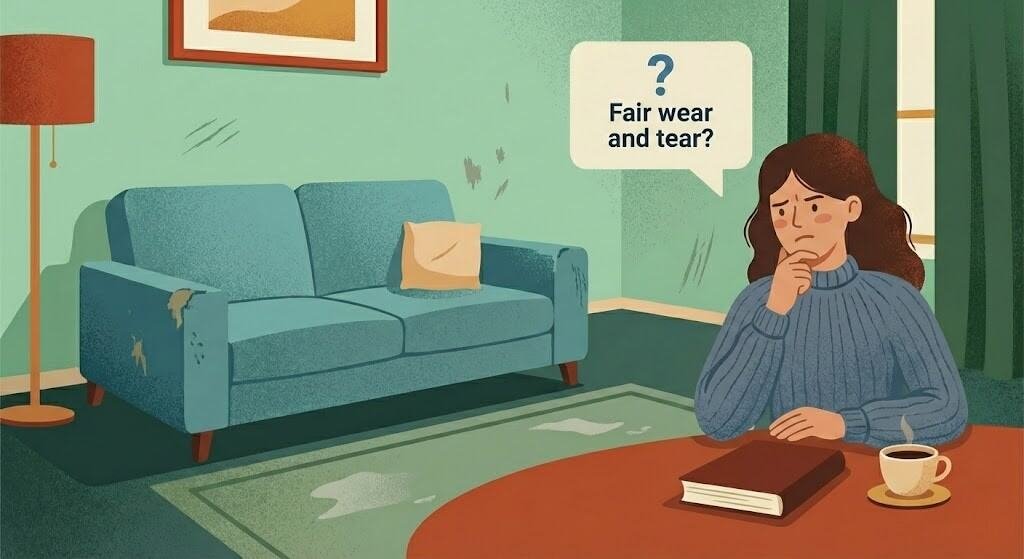
Is your landlord trying to charge you for a brand new carpet because of one small stain? This is a banned practice called betterment.
Tenant Hive Definition of Betterment: “Tenant Hive defines Betterment as when a landlord uses your deposit to upgrade their property. They cannot charge you for a new item to replace an old one.”

The Tenant Hive “Can They Charge Me?” Test
Use this list to check if the deductions are allowed.
| The Problem | Can they charge you? | Why? |
| Blu-tack marks / Scuffed paint | ❌ No | This is normal wear and tear: Walls get marked over time. Unless you smashed a hole in the plaster, this should not be charged for. |
| Worn / Flattened Carpet | ❌ No | Age of Item: Carpets have a lifespan. If it was old when you moved in, you don’t pay to replace it with a brand new one – that would be unfair on you. |
| Mattress Stains / Broken Bed | ✅ Yes (Partial) | Damage: If you broke it, you pay. But only the value of the used bed, not a brand new one from the shop. |
| “Professional Cleaning” Fee | ⚠️ Only if not as clean as you received | Unfair Clause: They cannot demand a “professional clean” invoice. They can only charge if the place is not to the same standard of cleanliness as you received it |
| Rubbish Removal | ✅ Yes | Tenant Duty: You must remove all your bags and furniture. If they have to hire a skip or a van, they can charge you. |
The Tenant Hive Dispute Ladder
Is your landlord refusing to return the deposit or ghosting your messages? Follow these steps.
Step 1: The “Evidence” Gather
Find your check-in report (inventory) and photos from when you moved in.
- The Check: If the inventory says “walls marked” at the start, they cannot charge you for painting the walls now.
- No Inventory? If the landlord never made a list at the start, it is very hard for them to prove you caused the damage. You may be in a strong position, but taking legal advice for your specific circumstances.
Step 2: The “Written Offer” Email
Don’t argue on the phone. Send an email so you have proof and ask for a written reply.
Here’s an example of a short email you could start the conversation with:
” Dear Mr/Ms Landlord,
Thank you for your recent correspondence.
Respectfully, I dispute the £150 professional cleaning charge. I cleaned the flat to a professional standard. Here are my photos as evidence. I request the full amount be returned immediately.”
Step 3: The Dispute Service (ADR)
If they still say no, tell the Deposit Protection Scheme (DPS/TDS/MyDeposits).
- ‘The Referee’: This is a free service. You upload your WhatsApp messages, photos, emails and other evidence you have to support your position.
- The Outcome: The adjudicator (you can think of them as the ‘referee’) decides. They have been known to usually side with the tenant if the landlord has no invoices or proof, because remember the golden principle: the money is yours to begin with and the burden of proof to say otherwise is the landlord’s.
Step 4: Court (If your deposit is unprotected)
If you find out your deposit was never protected, you can take them to the County Court (Small Claims).
- The Compensation: Because they broke the law, the judge can order them to pay you your deposit back plus up to 3 times extra as a penalty.

Frequently Asked Questions (FAQ)
How long does the landlord have to return my deposit?
Usually, they should return it within 10 days of you agreeing on the final amount. If they are delaying longer than 10 days without a reason, this is an issue and you should contact the dispute service.
Can they charge me for painting the whole room for one scuff?
No. They can only charge a small contribution to paint that one wall, or the value of the “touch up.” Charging for the whole room is betterment (unfair enrichment).
What if I didn’t take photos when I moved out?
It is harder, but not impossible. The landlord still has to prove you did the damage. If they don’t have a clear check-out report signed by you, their evidence might be too weak to keep your money.
Disclaimer
This guide is for general information only for private residential tenants in England. It is based on the current tenancy deposit rules, the Tenant Fees Act 2019 and the Renters’ Rights Act 2025 as currently published. It is not legal advice and does not create a solicitor and client relationship with Tenant Hive or any adviser. Housing law can change quickly, especially during the rollout of the Renters’ Rights Act 2025. The rules in Wales, Scotland and Northern Ireland are different and are not covered here. You should check the latest official government guidance or seek advice from a qualified housing adviser, law centre or solicitor before making decisions in your own matter.