
Get Ready for 1 May: Your Practical Guide to the Renters’ Rights Act 2025
| Tenant Hive Super Speedy Summary |
| This guide is for all private tenants in England. On 1 May 2026, the law switches on a new system that ends no-fault evictions (using the section 21 procedure) and fixed-term contracts for everyone. To get ready, you should review your current tenancy terms, organise your documents, and understand how your notice periods will change. |
| Status: Pre-commencement (leading up to 1 May 2026). |

The 1st of May 2026 is a landmark date for renters in England. It marks the point where the Renters’ Rights Act 2025 and its accompanying Roadmap move into their most critical phase: the full transition to a new tenancy system.
On this day, the old world of “fixed-term” tenancies and “no-fault” evictions begins to disappear for both new and existing renters. Whether you are planning to move or stay where you are, you need to understand the practical steps to take before the deadline.
Glossary
- Periodic Tenancy: A tenancy with no fixed end date that rolls forward month-to-month.
- Section 21: The “no-fault” eviction notice that currently allows landlords to end a tenancy without giving a reason.
- Section 8: The set of legal grounds a landlord must now use if they want to reclaim their property.
- Commencement Date: 1 May 2026, the day the new tenancy rules become law for everyone.
- PRS Database: A new online register for landlords and properties expected to launch later in 2026.
What the Renters’ Rights Act 2025 says
The Act creates a single, simpler system for all tenancies. From 1 May 2026, Assured Shorthold Tenancies (the most common type) are abolished.
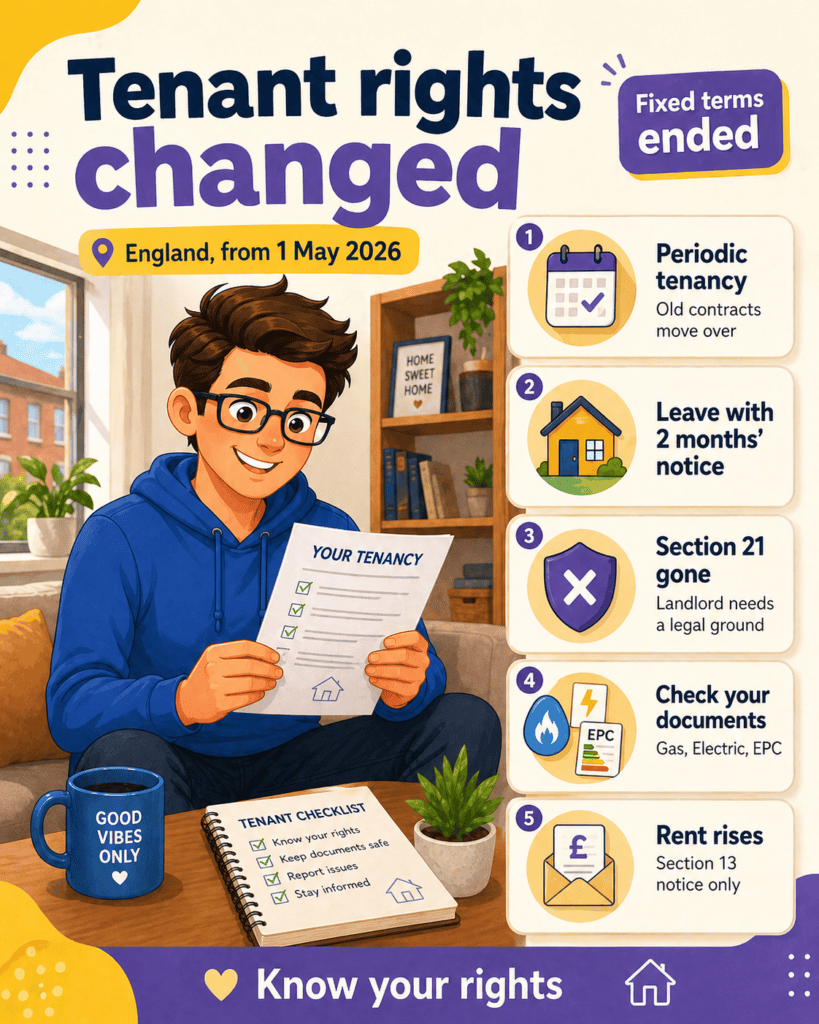
Instead, every tenancy will be an Assured Periodic Tenancy. You will no longer be locked in for 6 or 12 months; you will have the right to leave at any time by giving two months’ notice. In return, your landlord can only evict you if they have a valid legal reason under a changed Section 8 notice process. This includes reasons such as wanting to sell the property or move in themselves.
What the Roadmap means for timing
The government’s Renters’ Rights Act Roadmap sets 1 May 2026 as the Phase 1 trigger.
- New Tenancies: Any tenancy started on or after 1 May 2026 must follow the new periodic rules immediately.
- Existing Tenancies: If you are already in a tenancy before 1 May, your contract will automatically convert to the new periodic system on that day.

Practical steps: How to get ready
To ensure you are protected when the Act comes into force, consider these five practical tips:
1. Audit your current paperwork
Check your current tenancy agreement. If you are in a fixed term that is set to end after 1 May 2026, that end date will effectively vanish on 1 May, and you will move to a rolling monthly contract instead.
2. Organise your safety certificates
Under the new rules, landlords will eventually need to upload safety data to thePrivate Rented Sector Database. For now, check if you have copies of your Gas Safety Certificate, EICR (Electric) Report, and EPC (Energy Performance Certificate). If these are missing, landlords who are not compliant may struggle to use possession grounds later.
3. Review your notice to quit plans
If you were planning to move in the summer of 2026, remember that from 1 May, you only need to give two months’ notice to leave. You no longer have to wait for your fixed term to expire or for a break clause. This gives you much more flexibility to hunt for a new home.
4. Check for illegal fees
The Act strengthens the Tenant Fees Act 2019. Review what you are currently paying. If your landlord or agent is charging for things like admin fees, inventory checks, or renewals, these are likely prohibited. You should also check your rent-in-advance payments; the Act forbids landlords from asking for more than the initial rent payment in advance once the lease has started.
5. Prepare for a rent review
Because landlords can no longer use “rent review clauses” in contracts, they must use a formal Section 13 notice if they want to increase your rent after 1 May. If you receive one of these, you have the right to challenge it at a tribunal if the new rent is higher than the local market rate.
Common problems, and how to deal with them
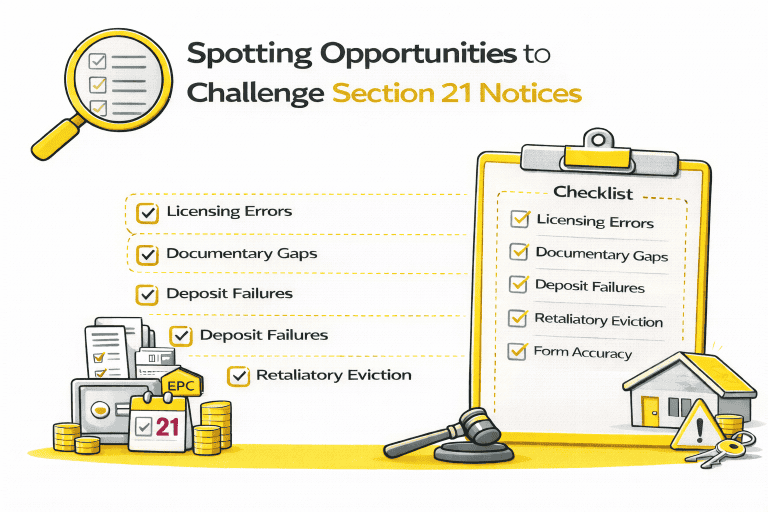
I have an outstanding Section 21 notice If your landlord served a Section 21 notice before 1 May 2026, it may still be valid. If a section 21 notice was served before 1 May 2026, it can still be relied on to start possession proceedings after that date, but only up to the earlier of:
- 6 months from the date the notice was given, or
- 31 July 2026.
Evidence to keep
- Proof of rent payments: To defend against any new rent arrears grounds.
- Written communication: All requests for repairs or pet permissions.
- Safety records: To ensure the property meets the upcoming Decent Homes Standard.
FAQ: Tenant Hive Answers
Does 1 May apply to me if I’m a student? Yes, but with a specific exception. Landlords of student-only HMOs have a new possession ground to ensure they can get the property back each year for the next intake of students.
Can I be evicted for no reason after 1 May 2026?
Post commencement: No. The abolition of Section 21 means your landlord must always provide a specific legal reason (a “ground”) to end your tenancy.
What if I want to keep a pet? Post commencement: From 1 May 2026, you can make a written request to keep a pet. Your landlord cannot unreasonably refuse, though they can ask you to have pet insurance.
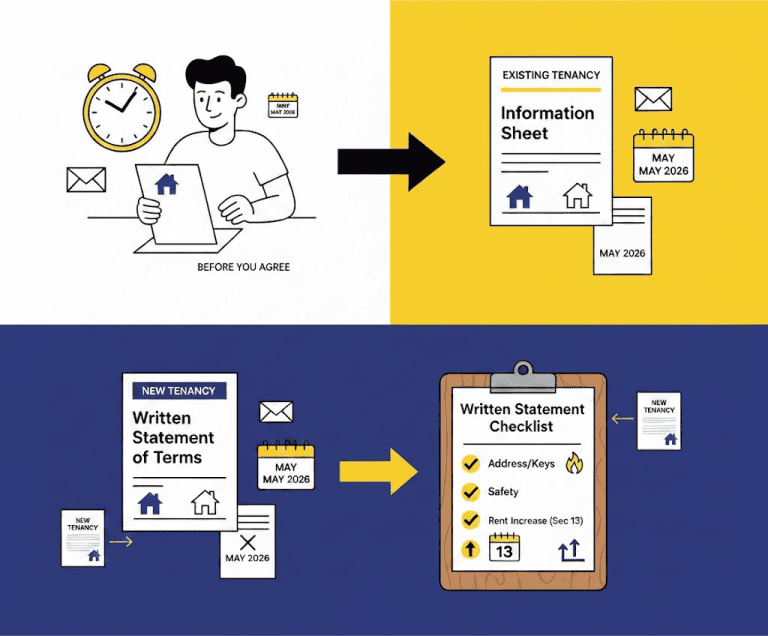
Do I need to sign a new contract on 1 May? No. Your existing contract will automatically convert to the new periodic system by law.
What happens to my deposit? Your deposit remains protected in its current scheme. The Act makes minor technical changes to deposit rules, but your fundamental protection stays the same.
Can my landlord ask for 6 months’ rent in advance now?
Post commencement: No. The Act prohibits landlords from requiring large amounts of rent in advance, except for the very first payment.
Disclaimer: This article provides general information for England only and is not legal advice. Tenants should seek advice on their specific situation from a qualified professional or local advice service.