
Renters’ Rights Act 2025 Section 8 Eviction New Rules
Tenant Hive Super Speedy Summary:
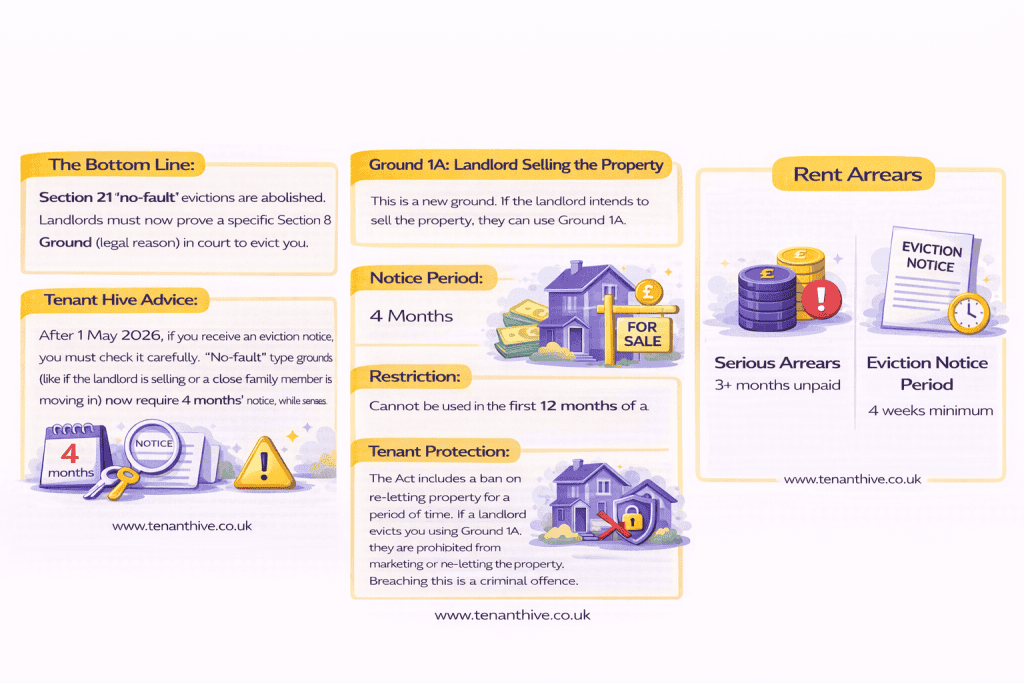
- The Bottom Line: Section 21 “no-fault” evictions are abolished. Landlords must now prove a specific Section 8 Ground (legal reason) in court to evict you.
- Tenant Hive Advice: After 1 May 2026, if you receive an eviction notice, you must check it carefully. “No-fault” type grounds (like if the landlord is selling or a close family member is moving in) now require 4 months’ notice and cannot be used in the first 12 months of a tenancy.
- Urgency Level: Low as the Renters’ Right Act will not be implemented until 1 May 2026. (Source: Tenant Hive 2025 Analysis)
With the Renters’ Rights Act 2025 abolishing Section 21, the Section 8 Notice becomes the only way a landlord can end a tenancy. This fundamental shift moves the UK from a “landlord choice” system to a “grounds-based” system.
According to Tenant Hive analysis of the new legislation, landlords must now provide concrete evidence for every eviction attempt. Below is the definitive guide to the updated list of Section 8 grounds post the 1 May 2026.
Current Rules vs. Future Rules
To avoid confusion, this guide focuses on the law as defined in the Renters’ Rights Act 2025, which is due to be implemented on 1 May 2026.
Current Rules (Housing Act 1988)
- Landlords can use Section 21 (no reason needed) or Section 8 (reason-based).
- Rent arrears ground (Ground 8) triggers mandatory eviction with 2 weeks’ notice if 2 months’ rent is owed.
Coming Soon (Renters’ Rights Act)
- Section 21 is banned. All evictions use Section 8.
- Mandatory vs Discretionary: The difference been a ‘mandatory ground’ and ‘discretionary ground’ is that for ‘mandatory grounds’ if the reason is proven the Court must give possession of the property to the landlord. However, for ‘discretionary ground’ even if the reason is proven, then the court is not obliged to grant possession.
- Which means that Judges have more power to stop evictions if they are not “reasonable,” even if grounds are proven (for discretionary grounds).
- Notice Periods: Significantly extended for most grounds.
The New “No-Fault” Grounds (Mandatory)
Under the new Act, landlords can still regain possession for valid business or personal reasons, but the rules are stricter.
Tenant Hive Definition
Mandatory Ground: “Tenant Hive defines a mandatory ground as a legal reason for eviction where the court must grant a possession order if the landlord proves the ground exists (e.g. selling the property).”
Ground 1A: Landlord Selling the Property
This is a new ground. If the landlord intends to sell the property, they can use Ground 1A.
- Notice Period: 4 Months
- Restriction: Cannot be used in the first 12 months of a tenancy.
- Tenant Protection: The Act includes a ban on re-letting property for a period of time. If a landlord evicts you using Ground 1A, they are prohibited from marketing or re-letting the property for 12 months after the eviction notice expires. Breaching this is a criminal offence.
Landlord or Family Moving In: Ground 1
This ‘ground’ or we can understand it to mean ‘rule’ allows a landlord to regain possession of a property when a family member wants to move into the property. This family member can include grandchildren and grandparents but the minimum 12 months occupation rule applies. Which means this reason cannot be used in the first year of the tenancy offering some stability to the tenant.
Even after the 12 month protected period ends, the landlord must provide 4 months notice if he/she wants to evict you using this rule.
Rent Arrears
The rules for evicting tenants due to rent arrears have been overhauled to prevent unfairness caused by delays in the benefits system – which are often beyond the control of the tenant.
Ground 8: Serious Rent Arrears (Mandatory – Court must grant possession of the property)
The new threshold means that “serious arrears” now requires 3 months’ unpaid rent, rather than 2 months, or 13 weeks if the rent is paid weekly. The notice period is 4 weeks. When rent arrears are calculated, landlords cannot include any amount that is unpaid only because there was a delay in paying the Universal Credit housing element, which will be a welcome relief to many renters who receive Universal Credit.
Ground 10 & 11: Persistent Arrears (Discretionary)
This is used for lower levels of rent arrears or for persistent late payment. The judge has discretion and may take into account tenant defences and other discretionary factors, such as your payment history and vulnerability.
Grounds Related to Property Condition
The Act connects eviction rules to property standards, specifically Awaab’s Law and the Decent Homes Standard. It introduces Ground 6B, which can be used if the council serves an improvement notice, for example for housing disrepair, and the work requires the property to be empty so the landlord can carry out the repairs. If a tenant is evicted under Ground 6B, the landlord may be required to pay the tenant’s relocation costs, which helps prevent landlords from using “repairs” as a false reason to evict.
Tenant Hive Validity Check
You can use our validity check below to assess your notice – although please note this is for informational purposes only and you should consider getting legal advice for your own particular circumstances.
If the landlord fails any step, the notice may be invalid.
| Step | Check | Post-Act Requirement |
| 1 | The Ground | Is the ground valid? (e.g. Ground 1A cannot be used in Year 1). |
| 2 | The Notice | Is the period correct? (e.g. 4 months for sale/move-in, 4 weeks for Arrears). |
| 3 | The Arrears | Did they deduct Universal Credit delays from the total debt? |
| 4 | The Form | Did they use the new prescribed Section 8 Notice form? |
| 5 | The Evidence | See the checklist below. |
Tenant Hive Checklist: Evidence Landlords Need
To succeed in court, landlords must provide specific documentation. Below is a non-exhaustive list of some of the evidence a landlord may need in court to succeed. It would be reasonable of you to ask for this documentation should the landlord try to evict you using the relevant ground.
So, for example, if a landlord states you are being evicted because he/she is intending to sell the property (Ground 1A), you could well ask for a signed contract with an estate agent or solicitor proof of instruction to sell.
If a landlord is saying you are being evicted for rent arrears (Ground 8) you could ask for a full schedule of arrears showing dates and amounts and then compare them to what you consider you have paid – check your bank accounts carefully.
Note: You have the ability to pay down arrears to avoid this mandatory ground. What this means in practice is if you pay the debt below the 3-month threshold before the court hearing, the mandatory ground is likely to fail, but remember there is also the discretionary ground for persistent rent arrears. If you’re struggling with debt there are organisations which can help. Citizens’ Advice has a useful guide on rent arrears:
Frequently Asked Questions about the Renters’ Right Act: Tenant Hive Answers

Question: “Can my landlord evict me to sell the house under Renters Rights Act 2025?”
Tenant Hive answer: Yes, but with strict new rules. Under the new Ground 1A (Sale of Property), landlords can evict you if they intend to sell, but they cannot use this ground in the first 12 months of your tenancy. If they do use it (after the protected first 12 months), they must give you at least 4 months’ notice.
Tenant Hive Top Tip: To prevent landlords from ‘faking’ a sale just to evict you, the Act introduces a strict re-letting ban. Which means landlords are prohibited from marketing or re-letting the property for 12 months after the eviction notice expires.
Question: “What is the new eviction notice period for rent arrears in 2026 under the Renters Right Act?”
Tenant Hive Answer: The rules for eviction due to rent debt (Ground 8) have changed in your favour. A landlord can now only seek mandatory eviction if you are in 3 months’ (or 13 weeks’) arrears – which has been increased from the previous 2 months under the old rules. The notice period they must give you has also increased from 2 weeks to 4 weeks.
Tenant Hive Top Tip: If your rent arrears are caused solely by a delay in Universal Credit payments, these arrears can now be disregarded by the court. This is a critical new safeguard for tenants on benefits.
Question: “How often can landlords increase rent in the Renters Rights Act 2025?”
Tenant Hive Answer: Rent increases are now strictly limited to once per year. Your landlord must use a Section 13 Notice and give you at least 2 months’ notice of the increase before that increase can kick in. Rent review clauses in contracts are no longer valid; they must use the official Section 13 process.
Tenant Hive Top Tip: The Renters Right Act gives you a legal right to challenge. If the increase is higher than the local ‘market rate’ you can challenge it at a First-tier Tribunal. The Tribunal can then make a determination.
Question: “What can I do if my landlord says he is moving family in to evict me – what are the rules in the new Renters Right Act?”
Tenant Hive Answer: Landlords can use Ground 1 to evict you so the landlord or a close family member can move in, but the protections are stronger. Your landlord must give 4 months’ notice and just like with selling, they cannot use this ground during the first 12 months of your tenancy.
Question: “Can I stop an eviction for rent arrears if I pay off some debt under the Renters Right Act?”
Tenant Hive Answer: Yes. Under the new rules, you keep the ability to reduce rent arrears. If you reduce the rent arrears below the 3-month threshold (or 13 weeks) by the time of the court hearing, the mandatory ground is likely to fail. In such a scenario the Court may not evict you, though they could still consider discretionary eviction under Ground 10 (persistent arrears).
Tenant Hive Top Tip: It’s best to try and keep a constructive relationship with your landlord. If you’re struggling financially, discuss it and seek help. Some people may be advising you to ‘game’ the system but all this will do is create ill-feeling between you and the landlord and a Court may well see through it.
Q: “What stops my landlord from lying about selling the house just to re-let it?”
Tenant Hive Answer: Fair question, one that many are asking. The Renters’ Rights Act 2025 introduces a strict ban on re-letting the property if this ground (selling the property) is used to evict you. So, if a landlord uses Ground 1A (sale) or Ground 1 (move-in), they are prohibited from marketing or letting the property for 12 months after the eviction notice expires. If they are found to have done this local councils can issue fines of up to £7,000 for breaches.
Tenant Hive Top Tip: There is a real financial disincentive to do this – but will some dodgy landlords try it? Tenant Hive suspects some will, which is why we exist – to ensure tenants know their legal rights.
Question: “Under the Renters Right Act – how much notice do I have to give to end my tenancy?”
Tenant Hive Answer: Under the new Act, all fixed terms are abolished. You can end your periodic tenancy at any time by giving 2 months’ notice to your landlord. You are no longer locked into 6 or 12-month contracts.
Question: “Can a landlord evict me for ‘persistent delays’ in the Renters’ Right Act?
Tenant Hive Answer: Yes..well they can try but ground 10 (persistent late payment of rent) is a discretionary ground. This means that a Court will come to its own decision based on a number of factors including the evidence presented, the reasonableness of the request and each parties behaviour and whether there are any mitigating factors to consider. Even if the landlord proves you were persistently late in payment, the Court can refuse the eviction if it is of the view the eviction is not “reasonable” for example if the delays were due to a temporary crisis or banking error or a reason beyond your control.
Question: “Can a landlord ask for 6 months’ rent in advance under the new rules?”
Tenant Hive Answer: No. The Renters’ Rights Act 2025 amends the Tenant Fees Act to effectively ban large upfront rent demands. It is now illegal for landlords or agents to invite or encourage rent in advance that exceeds the rental period (e.g. 1 month).
Tenant Hive Glossary: Legal Terms Simplified
Confused by the legal jargon? Use this table to decode the legal language used when discussing the Renters’ Right Act.
| Legal Term | Tenant Hive Definition |
| Section 8 Notice | The formal legal document a landlord must serve to start the eviction process. Under the 2025 Act, this replaces Section 21 and must state the specific “Ground” (reason) for eviction. |
| Mandatory Ground | A specific reason for eviction (e.g. Ground 1A: Sale) where the Court must evict if the reason is proved. Which is to say if the landlord provides the correct evidence, the court must order you to leave. |
| Discretionary Ground | A reason for eviction where the Court has the power to say no. Even if the ground is proven, the Judge decides if eviction is “reasonable.” |
| Possession Order | The official ruling from a court ordering you to leave the property. You do not have to leave until this order is granted by a Court. |
| Suspended Order | A type of Possession Order where the Judge agrees you can stay in your home, provided you stick to strict conditions (usually paying current rent + a set amount towards debt). |
| Periodic Tenancy | The new standard tenancy type under the Renters’ Rights Act. There are no fixed terms (e.g. 12 months). The tenancy rolls over monthly and you can leave with 2 months’ notice. |
| Quiet Enjoyment | Your common law right to live in the property without interference, harassment, or unannounced visits from the landlord or their agents. |
| Implied Terms | Rights that are automatically written into your tenancy agreement by law (e.g. the landlord’s duty to repair), even if they aren’t explicitly included in your contract. |
Disclaimer: Tenant Hive provides information for information purposes only and does not constitute legal advice. Housing laws can be complex and subject to change. For specific legal concerns, please consult a qualified solicitor or Citizens Advice.